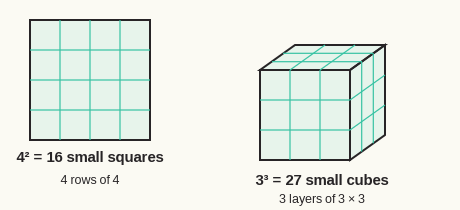
Pick one topic. Use the video where shown, read the short explanation, then try the question before checking your answer.
1. Square numbers and visual patterns
Watch: Describing numerical relationships with polynomial identities
Khan Academy
Video not loading? Watch on YouTube (opens in a new tab)
Understand it
Draw a 3 by 3 square of tiles. To grow it into a 4 by 4 square, add 4 tiles along one edge and 3 along the other: 7 new tiles. The corner is counted once. For an n by n square, the next border adds (n + 1) + n = 2n + 1 tiles.
Try it yourself
What is the difference between 13² and 12²?
Check: 25, because (12 + 1)² - 12² = 2 × 12 + 1.
2. Square roots and estimating roots
Watch: Approximating square roots
Khan Academy
Video not loading? Watch on YouTube (opens in a new tab)
Understand it
A square root tells you the nonnegative side length of a square of a given area. To estimate √70, compare 8² = 64 with 9² = 81: √70 is between 8 and 9. Squaring 8.3 and 8.4 narrows the bound to 8.3 < √70 < 8.4. In the video's final example, the corrected bound is 11 < √123 < 12, not 144.
Try it yourself
Between which consecutive integers does √70 lie?
Check: 8 and 9, because 64 < 70 < 81.
3. Cubes and cube roots
Watch: Dimensions of a cube from its volume
Khan Academy
Video not loading? Watch on YouTube (opens in a new tab)
Understand it
A cube has three equal dimensions. For 216, factor it as 2³ × 3³. Take one factor from each triplet: ∛216 = 2 × 3 = 6. Check the result by multiplying 6 × 6 × 6. The video works through the related cube with volume 512 cm³.
Try it yourself
Find ∛216 and explain the result.
Check: 6, because 6 × 6 × 6 = 216.
4. Recognising perfect squares and cubes
Watch: Simplifying square roots
Khan Academy
Video not loading? Watch on YouTube (opens in a new tab)
Understand it
Prime factors help you recognise perfect powers. A perfect square has complete pairs of prime factors; a perfect cube has complete triplets. In 72 = 2³ × 3², one 2 is left unpaired, so it is not a perfect square. The video shows the pair-grouping idea with square roots; apply triplets separately for cubes.
Try it yourself
Is 72 a perfect square?
Check: No. Its prime factors are 2³ × 3², so one factor 2 remains unpaired.
Your five-minute revision
Choose one idea you can now explain and one you still find tricky. Draw a diagram or work an example from memory. Compare with the lesson and fix the step you missed, then retry it tomorrow.
Try an Evater sample paper and choose questions that match what you have practised.
Written by
Evater Team