Pick one topic. Use the video where shown, read the short explanation, then try the question before checking your answer.
1. Fractions, decimals and percentages
Watch: Fraction, decimal, and percent from visual model
Khan Academy
Video not loading? Watch on YouTube (opens in a new tab)
Understand it
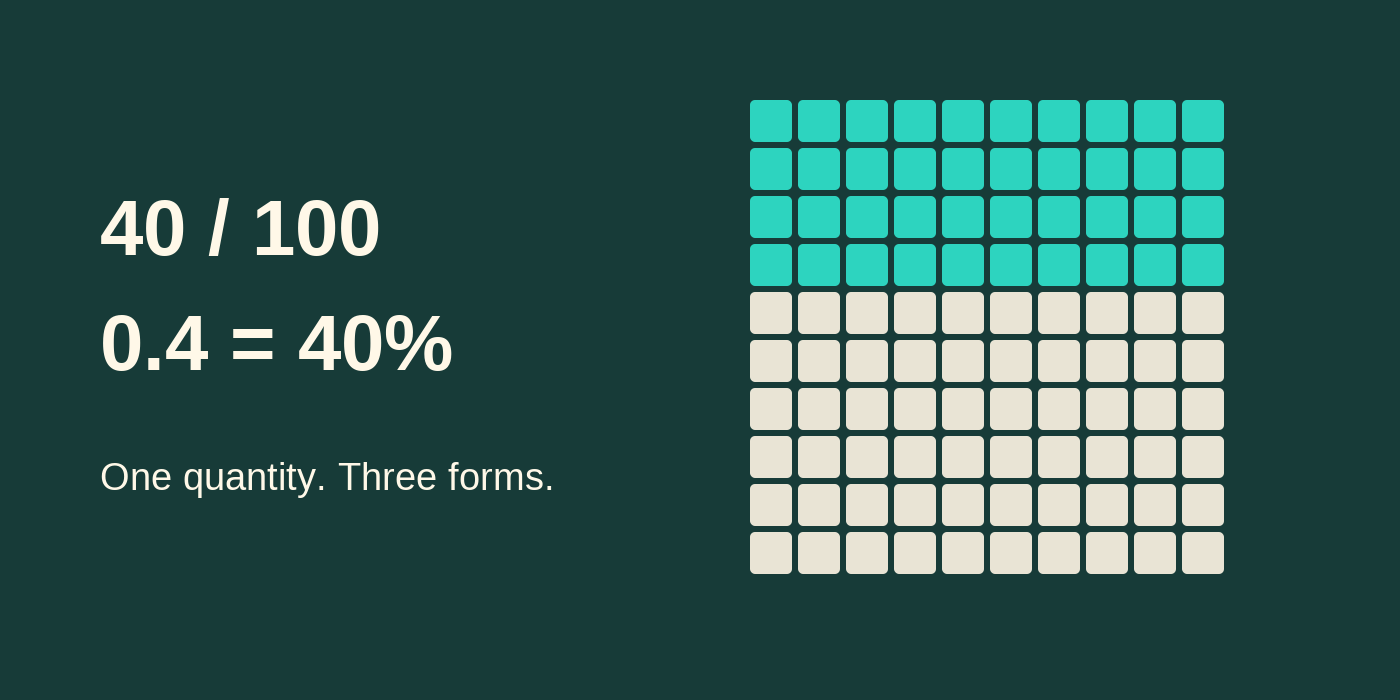
A fraction, decimal and percentage can name the same share of a whole. For 7/20, divide 7 by 20 to get 0.35, or make an equivalent fraction 35/100. Both give 35%. Multiplying the decimal by 100 changes the notation to percent; it does not change the represented share.
Use a benchmark to catch place-value errors: 7/20 is more than 1/4 but less than 1/2, so its percentage should lie between 25% and 50%. The denominator tells you how the whole is divided. Seven shaded parts out of twenty equal parts is not 7% and not 35 whole objects.
Try it yourself
Write 11/40 as a decimal and percentage. Give the unshaded share in all three forms if 11 of 40 equal parts are shaded. Use one-quarter as a check on the shaded answer.
Check: 11/40 = 0.275 = 27.5%, just above 1/4 = 25%. The unshaded share is 29/40 = 0.725 = 72.5%. The shares add to 1, the decimals to 1.000 and the percentages to 100%; 27.5% is not 0.275%.
2. Finding a percentage of a quantity
Watch: Percentages without a calculator - Corbettmaths
corbettmaths
Video not loading? Watch on YouTube (opens in a new tab)
Understand it
A percentage is a fraction of a named whole. Seventeen and a half percent of 240 can be built from 10%, 5% and 2.5%: 24 + 12 + 6 = 42. Equivalently, 17.5/100 × 240 = 42. Write the whole and its unit before calculating. If the whole is a mass, the answer is a mass, not another percentage.
A larger percentage does not always give a larger amount when the wholes differ. You must calculate each share using its own whole. As a reverse check, dividing the amount by the decimal percentage should recover that whole.
Try it yourself
Bag A has mass 360 g, of which 12.5% is red counters. Bag B has mass 200 g, of which 20% is red counters. Which bag has the greater mass of red counters, and by how much? Explain why comparing only 12.5 and 20 would fail.
Check: Bag A has 1/8 × 360 = 45 g of red counters; bag B has 1/5 × 200 = 40 g. A has 5 g more despite its lower percentage, because its whole is larger. The reverse check 45 ÷ 0.125 = 360 recovers A's whole mass.
3. Percentage increase and decrease
Watch: Percentage Change - Corbettmaths
corbettmaths
Video not loading? Watch on YouTube (opens in a new tab)
Understand it
Percentage change compares the change with the original amount: change/original × 100%. A rise from ₹160 to ₹200 adds ₹40, which is 25% of ₹160. Returning from ₹200 to ₹160 removes the same ₹40, but the downward change starts from the original ₹200, so the decrease is 20%. Equal rupee changes need not be equal percentage changes.
For repeated changes, apply each percentage to the amount at that step. A 20% rise multiplies by 1.20; a 20% fall multiplies by 0.80. Their product is 0.96, not 1.00. Writing each new base prevents the tempting but incorrect cancellation of equal-looking percentages.
Try it yourself
A hypothetical price of ₹500 rises by 20%, then the new price falls by 20%. Find both new prices and the net percentage change from ₹500. What percentage reduction from the intermediate price would return exactly to ₹500?
Check: The rise gives ₹600; 20% of ₹600 is ₹120, so the fall gives ₹480. The net change is a ₹20 decrease, or 4% of the original ₹500. To return from ₹600 to ₹500, reduce by ₹100/₹600 × 100% = 16⅔%, not 20%. The two changes use different bases.
4. Applying percentages in context
Think it through
A discount is taken from the marked price. Fifteen percent of ₹800 is ₹120, so the sale price is ₹680 before other charges. Profit or loss percentage usually uses cost price instead. Underline the quantity that counts as the whole before calculating any percentage.
Try it yourself
A ₹800 item has a 15% discount. What is the sale price before any other charge?
Check: ₹680. The discount is ₹120.
Your five-minute revision
Choose one idea you can now explain and one you still find tricky. Draw a diagram or work an example from memory. Compare with the lesson and fix the step you missed, then retry it tomorrow.
Try an Evater sample paper and choose questions that match what you have practised.
Written by
Evater Team