Start with an everyday object. Ask what is pushing or pulling it, in which direction, and what changes. Use the videos and short activities below to test your explanation.
1. What can a force do?
Think it through
A push or pull can change an object's speed, direction or shape. But a force does not always make an object move: a book can stay still on a table because the downward pull of gravity is balanced by the table's upward support force.
Draw the book and two arrows. Label what exerts each force. When the forces balance, there is no change in the book's motion.
Try it yourself
Gently press a soft sponge on a stable table. What changes? Now think about a ball rolling straight ahead: what could change its direction?
Check: The sponge changes shape. A sideways push can change the ball's direction. Describe the objects interacting, not only the change you see.
2. Contact and non-contact forces
Watch: Recognizing Force Types
The Physics Classroom
Video not loading? Watch on YouTube (opens in a new tab)
Understand it
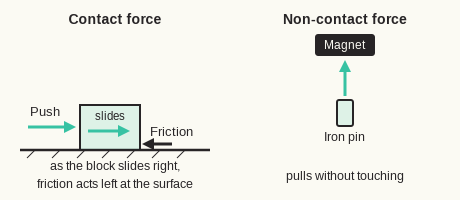
Some forces need contact: a hand pushes a door, a table supports a book, and friction acts between touching surfaces. Gravity, magnetic forces and electrostatic forces can act without direct contact. The video uses extra names such as normal force and tension; focus first on what exerts each force and whether the objects touch.
Try it yourself
Classify these: a stretched rope pulling a bucket, Earth pulling a falling leaf, and a magnet attracting a paper clip before they touch. Draw one force arrow for each.
Check: The rope's pull is a contact force. Gravity and the magnetic force are non-contact forces. Point each arrow in the direction of the pull on the object you chose.
3. Why friction matters
Watch: Slipping, Sliding Science!
SciShow Kids / Complexly
Video not loading? Watch on YouTube (opens in a new tab)
Understand it
Friction acts between touching surfaces and resists their relative sliding or tendency to slide. It can slow a sliding book, but it also gives your shoes grip while you walk. The video introduces the idea through simple examples; now practise explaining the direction of friction.
With an adult or teacher, gently slide a closed book across two dry, stable surfaces. Compare how quickly it slows. Keep the demonstration small: do not run or slide on wet floors or plastic sheets. Roughness is a useful first model, not a rule that every smoother surface always has less friction.
Try it yourself
A book slides to the right across a table. Which way does friction act on the book? Why would a world with no friction make walking difficult?
Check: Friction acts to the left on the sliding book. Walking needs grip between your foot and the ground. Remember: friction can help us as well as slow things down.
4. Mass, weight and floating
Think it through
Mass is measured in kilograms. Weight is the gravitational force on an object, measured in newtons. The same object can have the same mass but a different weight where gravity is different.
Water pushes upward on an immersed object. For an object floating at rest, this upward buoyant force balances its weight. A heavy object does not automatically sink: whether it floats also depends on its overall density and how much water it displaces. A hollow boat can displace enough water to support its weight.
Try it yourself
Explain why "heavy things sink and light things float" is not a reliable rule. Then draw the two vertical forces on a boat floating at rest.
Check: Total weight alone is not enough to decide. The upward buoyant force and downward weight balance for a boat floating at rest. Use the force balance in your explanation, not just the word "light".
Your five-minute revision
Choose a book on a table, a sliding toy and a floating boat. For each, name the interacting objects, draw force arrows, and explain whether the motion changes. Cover your first drawing and repeat it from memory. Fix one missing force or direction at a time.
Try an Evater sample paper and choose force questions that test your explanations.
Written by
Evater Team