
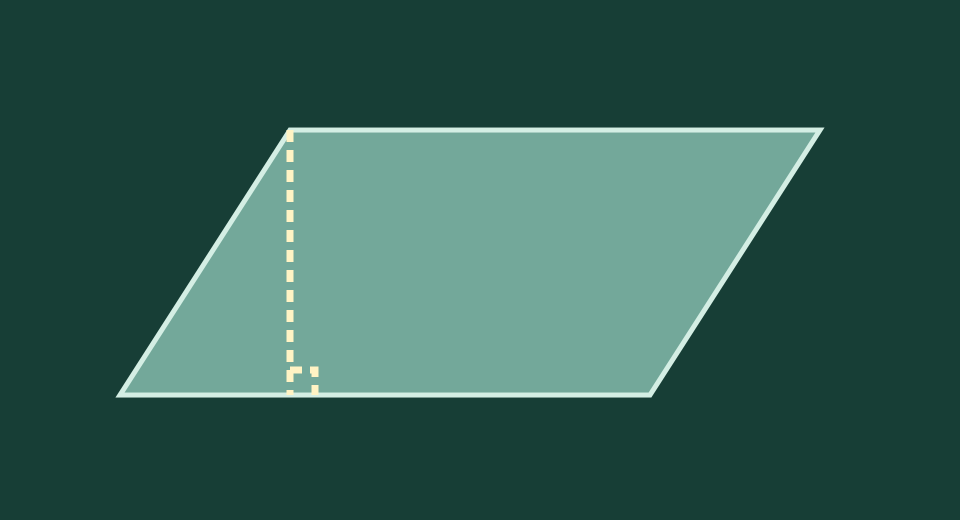
The height has a right-angle job
A parallelogram has base 8 cm, a sloping side of 5 cm and perpendicular height 3 cm. Which second measurement belongs with the base in its area calculation? Use 3 cm. The area is 8 × 3 = 24 cm². Multiplying by the sloping side would count the wrong region.
Area measures a surface with unit squares. Perimeter measures the length around its boundary. A line can be measured in centimetres; a region needs square centimetres. This distinction is more useful than memorising a page of formulas without knowing which measurements go together.
This guide covers Ganita Prakash Part II, Chapter 7: Area. Evater's combined Maths chapter sequence calls it chapter 14; that platform order is different from the book's Part II chapter number. The examples and diagrams below are original Evater material, not copied exercise answers.
Equal perimeter does not mean equal area
A 2 cm by 8 cm rectangle has perimeter 2(2 + 8) = 20 cm and area 16 cm². A 4 cm by 6 cm rectangle also has perimeter 20 cm, but area 24 cm². The same length of fence can enclose different amounts of ground.
To compare two regions, first say what is fixed. A fixed perimeter alone does not fix the area. A fixed base and its matching perpendicular height do fix the area of a triangle. A diagram can reveal which situation you actually have.
Rearrange a parallelogram into a rectangle
Draw a perpendicular from the upper-left corner of a slanted parallelogram to its base line. For a suitable simple slant, cut off the resulting triangular piece and move it to the other side. Nothing is stretched or overlapped, so the total area stays the same. The new rectangle has the parallelogram's base and perpendicular height.
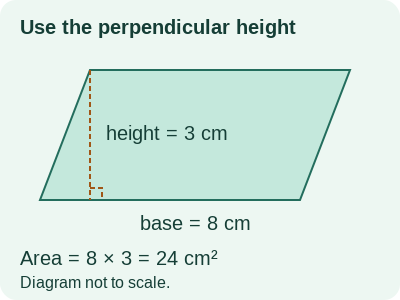
This gives area = base × perpendicular height. If you choose a different side as the base, you must use the height perpendicular to that side. You cannot keep one side's height and swap in another side's length.
The interactive diagram below slides the top of a parallelogram sideways while keeping base and height unchanged. Its sloping side changes but its area does not. This 2D model is more direct for area than a decorative 3D object.
Why a triangle has half the area
Two congruent copies of a triangle can form a parallelogram. The parallelogram has twice the triangle's area, with the same base and perpendicular height. Therefore triangle area = ½ × base × height.
For a triangle with base 10 cm and matching height 6 cm, the area is 30 cm². The height is the perpendicular distance from the opposite vertex to the line containing the base. In an obtuse triangle, that perpendicular can fall outside the triangle, on an extension of the base. It is still the correct height.
Do not substitute a sloping side just because the diagram prints its length clearly. Look for the right-angle marker, or draw the perpendicular yourself.
Same base and between the same parallels
If two triangles share a base and their opposite vertices lie on a line parallel to it, they have equal perpendicular heights. Their areas are therefore equal. They need not have the same sloping sides or be congruent.
A triangle's median joins a vertex to the midpoint of the opposite side. The two smaller triangles have equal base lengths and share the same height from that vertex. Each has half the original triangle's area. Equal area alone does not prove the two triangles are congruent.
Build polygon areas from pieces
For a composite shape, draw non-overlapping triangles and rectangles whose union is exactly the region. Find each area and add. If you instead draw a large surrounding rectangle, subtract the parts outside the shape. Do not add an overlapping piece twice or subtract a gap that belongs inside the required region.
An L-shaped floor can be described as a 9 m by 7 m rectangle with a 3 m by 2 m corner missing. Its area is 63 − 6 = 57 m². This calculation assumes the removed corner is a rectangle with the stated perpendicular sides. A sketch should label that assumption rather than leave the missing piece ambiguous.
Rhombus and trapezium formulas with reasons
A rhombus's diagonals bisect at right angles. Four right triangles make up its area. Adding their areas gives ½ × d₁ × d₂. If the diagonals are 12 cm and 16 cm, the area is 96 cm². The two diagonal lengths are not the same thing as the side and height measurements used in base × height.
A trapezium with parallel sides a and b and perpendicular height h has area ½(a + b)h. One way to see this is to join a second congruent copy to form a parallelogram of base a + b and height h. The original occupies half its area. For parallel sides 5 m and 9 m with height 4 m, the area is 28 m².
Units must be converted twice
One metre contains 100 centimetres. A square metre is 100 cm by 100 cm, so 1 m² = 10,000 cm², not 100 cm². Convert all lengths to one unit before multiplying, or convert the final area with the square of the length conversion factor.
Six checks before you leave
- A parallelogram has base 9 cm, sloping side 7 cm and matching height 4 cm. Find its area.
- Two triangles have base 12 cm and heights 5 cm. Must they be congruent? Compare their areas.
- Find a triangle's area when its base is 14 cm and external perpendicular height is 3 cm.
- A 10 m by 8 m rectangular floor has a 2 m by 3 m rectangular corner removed. Find the remaining area.
- Find a rhombus's area from diagonals 10 cm and 18 cm.
- A trapezium has parallel sides 6 cm and 10 cm and height 5 cm. Find the area, then express it in mm².
Answer check: 1) 36 cm², not 63. 2) Each is 30 cm², but congruence is not guaranteed. 3) 21 cm²; an external height is valid. 4) 80 − 6 = 74 m². 5) 90 cm². 6) 40 cm² = 4,000 mm². For each answer, name the perpendicular measurement or decomposition you used.
Practise without a false promise
Open the Evater chapter chooser, select Mathematics and look for Area. Evater is free to try. Its platform sequence is 14, while the book identity is Part II Chapter 7. This article does not claim that Area's full question content or start-to-result flow has been verified, and it does not invent a direct concept target.
Sources and verification limits
NCERT Part II contents and preface establishes the book identity and scope. The official Area chapter link was unreachable in the latest check. Relevant chapter text was read from the attributed eVidyarthi copy, covering unit squares, perimeter comparisons, perpendicular heights and quadrilateral areas. This is not a claim that the latest official PDF bytes have been verified. All examples and calculations in this guide are original and independently checked.
Slide the top, keep the area
Change the sideways shift while holding base and height fixed. The sloping side changes; the perpendicular height does not.
Not to physical scale. Lengths in units.
Area = 8 × 3 = 24 square units. A triangle with this base and height has area 12 square units.
Sloping side ≈ 3.61 units. The dashed line is perpendicular to the base line, even when it falls outside the shape. A 2D area model, not a 3D simulation.
Written by
Evater Team