

Start with the operation, not the rule
A small raised number can hide a big change. In 3⁴, the base is 3 and the exponent is 4: multiply four factors of 3. The result is 81. It is not 3 × 4. Before using an exponent law, say what operation joins the expressions: addition, multiplication, division or another power. Different operations need different reasoning.
This guide follows the ideas in Ganita Prakash Part I, Chapter 2: Power Play. All worked examples and check questions below are original Evater examples. They are not a reproduction of the textbook exercises.
See why powers grow quickly
Imagine a counter that starts at 1 and doubles at each step. Its values are 1, 2, 4, 8, 16 and 32. After n steps its value is 2ⁿ. Contrast this with a counter that adds 2 each time: 1, 3, 5, 7, 9 and 11. Both get bigger, but the multiplication pattern gets bigger much faster.
A repeated-folding story can model doubling thickness, but the arithmetic model is not a promise that a real sheet can be folded indefinitely. Material, size and force limit a physical experiment. Use the model to ask what repeated multiplication does, not to make an impossible practical instruction.
Multiplying powers with the same base
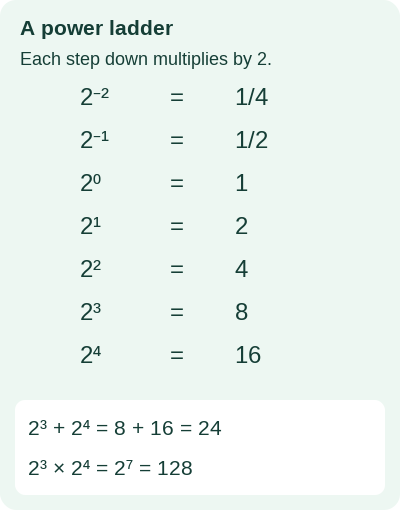
Write out the factors in 2³ × 2⁴. The first power contributes three factors of 2 and the second contributes four. Together there are seven factors, so 2³ × 2⁴ = 2⁷ = 128.
For positive integer exponents, this explains aᵐ × aⁿ = aᵐ⁺ⁿ. The rule also extends consistently to integer exponents when a is nonzero. The base must match: 2³ × 3⁴ cannot be collapsed by adding 3 and 4.
Addition is different. 2³ + 2⁴ = 8 + 16 = 24, not 2⁷. A useful pause before every solution is: am I joining groups of factors, or adding two values?
Dividing powers and reaching zero
In 5⁴ ÷ 5², cancel two common factors of 5 from numerator and denominator. Two remain, giving 5² = 25. For nonzero a, aᵐ ÷ aⁿ = aᵐ⁻ⁿ.
Now use the same idea with equal exponents. 7³ ÷ 7³ = 1, while subtracting exponents gives 7⁰. The consistent definition is therefore 7⁰ = 1. In general, a⁰ = 1 for a ≠ 0. This argument does not define 0⁰, because dividing zero by zero is not allowed. Do not silently apply the nonzero-base rule to that expression.
Move another step left on the ladder: 5⁰ ÷ 5 = 1/5, which is 5⁻¹. Another division gives 5⁻² = 1/25. A negative exponent tells you to take a reciprocal; it does not automatically make the answer negative. For nonzero a and positive integer n, a⁻ⁿ = 1/aⁿ.
A power raised to another power
Compare (2³)⁴ with 2³ × 2⁴. The first means four copies of the entire 2³ multiplied together, so it contains twelve factors of 2. Thus (2³)⁴ = 2¹² = 4096. The second contains seven factors and equals 128.
For integer exponents with a nonzero base, (aᵐ)ⁿ = aᵐⁿ. For a product, each factor is repeated: (ab)ⁿ = aⁿbⁿ. Likewise, (a/b)ⁿ = aⁿ/bⁿ when the expressions are defined and b is nonzero. If negative exponents occur, a must also be nonzero.
Brackets matter for signs. (−3)² = 9 because the whole negative number is squared. But −3² is interpreted as −(3²) = −9. Rewrite the expression with brackets before calculating if a sign is easy to lose.
Scientific notation is a place-value tool
In standard scientific notation, write a positive number as c × 10ᵏ with 1 ≤ c < 10 and integer k. For example, 52,000 = 5.2 × 10⁴. The expression 52 × 10³ has the same value but its coefficient is too large for standard scientific notation.
A small value works the same way: 0.00063 = 6.3 × 10⁻⁴. Check by moving the decimal back: four divisions by 10 turn 6.3 into 0.00063. For two positive numbers in this form with different exponents, the one with the larger exponent is larger. If the exponents match, compare the coefficients. If either number is not in standard form, normalize first.
Six checks before you leave
- Evaluate 2³ + 2⁴ and explain why the product law does not apply.
- Simplify (3²)³, then compare it with 3² × 3³.
- Explain 11⁰ without saying that anything multiplied by zero is one.
- Evaluate 4⁻² as a fraction.
- Put 72 × 10³ into standard scientific notation.
- One counter adds 3 each step; another multiplies by 3. Both start at 1. List their first four values, including the starting value.
Answer check: 1) 24, because this is addition. 2) 3⁶ = 729, versus 3⁵ = 243. 3) 11²/11² = 1 = 11⁰. 4) 1/16. 5) 7.2 × 10⁴. 6) Addition: 1, 4, 7, 10; multiplication: 1, 3, 9, 27. If a result surprises you, return to a small list of factors before memorising another rule.
Try the visual model and then practise
The model below lets you compare repeated addition with repeated multiplication. It is a mathematical diagram, not a 3D physical folding simulation. Change a control, predict the result and explain which operation produced it.
Open the Evater chapter chooser, then choose Mathematics and Power Play. Evater is free to try. The chooser includes this chapter, but its full question content and start-to-result journey were not verified for this article; this link is not a promise of an already certified concept-only test.
Source and scope
NCERT Power Play, Ganita Prakash Part I Chapter 2 supports the chapter identity, growth patterns, exponent laws and negative powers. Relevant chapter text was read. Examples, diagrams and explanations here are original. This is a study guide, not an official NCERT answer key or a claim about exam weightage.
Try it: add or multiply?
Both counters start at 1. One adds the chosen number each step; the other multiplies by it. Predict before changing a control.
Repeated addition
1 + 2 × 4 = 9
Repeated multiplication
24 = 16
- Step 0Add: 1 · Multiply: 1
- Step 1Add: 3 · Multiply: 2
- Step 2Add: 5 · Multiply: 4
- Step 3Add: 7 · Multiply: 8
- Step 4Add: 9 · Multiply: 16
A mathematical counter model, not a prediction of unlimited physical paper folding. At step 0, neither operation has been applied.
Written by
Evater Team