
What this chapter is about
Ganita Prakash, the new Class 8 Maths textbook, opens with a puzzle. Queen Ratnamanjuri leaves 100 lockers and 100 relatives: person 1 opens every locker, person 2 toggles every second locker, person 3 toggles every third, and so on. Which lockers stay open at the end? The answer introduces the two heroes of the chapter: square numbers and cubic numbers.
The locker insight worth remembering
Only the lockers numbered 1, 4, 9, 16, 25 and the other perfect squares stay open, because squares are the only numbers with an odd number of factors.
Why? Factors come in pairs: for 12, the pairs are 1-12, 2-6 and 3-4, an even count. But for 36, the factor 6 pairs with itself, so the count is odd. A locker is toggled once for each factor, so only square-numbered lockers are toggled an odd number of times and stay open. If you can explain this in your own words, you have understood the heart of the chapter.
Square numbers
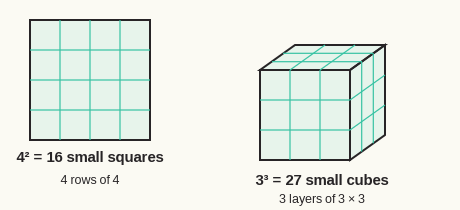
A square number is a number multiplied by itself: n x n = n². The name comes from area: a square of side 5 units holds 25 unit squares. Know the first fifteen squares on sight: 1, 4, 9, 16, 25, 36, 49, 64, 81, 100, 121, 144, 169, 196, 225. They return constantly in later chapters, especially in the Baudhayana-Pythagoras theorem.
Cubic numbers
A cubic number is a number multiplied by itself twice: n x n x n = n³. The picture is volume: a cube of side 3 units holds 27 unit cubes. The first ten cubes are 1, 8, 27, 64, 125, 216, 343, 512, 729, 1000. Square and cube roots are simply the reverse questions: which number squared gives 144, and which number cubed gives 343?
Common mistakes to avoid
- Writing 3 squared as 6. Squaring means multiplying the number by itself: 3 x 3 = 9, not 3 x 2.
- Thinking a cube is "the square times 3". 4 cubed is 4 x 4 x 4 = 64, not 4 x 4 x 3 = 48.
- Forgetting that 1 is both a perfect square (1 x 1) and a perfect cube (1 x 1 x 1).
How to practise this chapter
Close the book and write the first fifteen squares and first ten cubes from memory, then check. When you meet a number like 729, ask whether it is a square, a cube, or both (it is both: 27 squared and 9 cubed). Short mixed question sets turn this into reflex. Evater practice tests can help you turn chapter reading into an attempt-and-feedback loop, free to try.
Explore in 3D
Build a cube, one layer at a time
A square counts unit squares. A cube stacks square layers. Change the side length, then reveal the layers to see why volume is n x n x n.
One layer: 3 x 3 = 9 square units.
Shown: 9 x 3 = 27 cubic units.
Full cube: 3 x 3 x 3 = 27 cubic units.
Try this: set the side to 4. Each layer has 16 unit cubes, so four layers make 64. If you show only two layers, you have a rectangular prism with 32 unit cubes, not the full cube.
Written by
Evater Team