What this chapter is about
Chapter 9 of the new Class 8 Maths textbook (Ganita Prakash) introduces one of the oldest results in all of geometry: the relationship between the three sides of a right-angled triangle. You may know it as the Pythagoras theorem. The new book calls it the Baudhayana-Pythagoras theorem, because the Indian mathematician Baudhayana stated the same result in the Sulba-sutras a couple of centuries before Pythagoras.
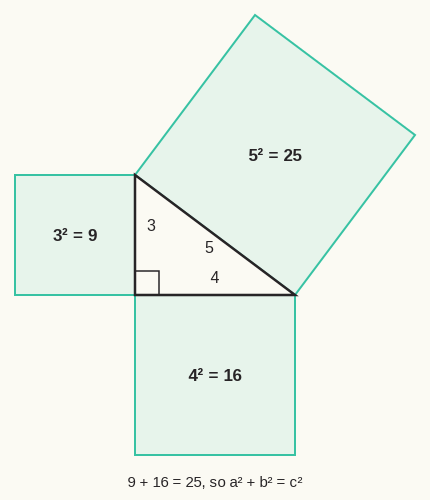
In a right-angled triangle, the square of the hypotenuse equals the sum of the squares of the other two sides.
Written as a formula: a² + b² = c², where c is the hypotenuse. The hypotenuse is the side opposite the right angle, and it is always the longest side.
See it before you memorise it
Draw a triangle with sides 3 cm, 4 cm and 5 cm. The angle between the two shorter sides is 90°. Now draw a square on each side and count the areas: 3² = 9, 4² = 16, 5² = 25. And 9 + 16 = 25. Try it again with 6, 8 and 10: 36 + 64 = 100. Once you have seen this with your own eyes, the formula stops being a line to memorise and becomes something you have checked yourself.
Three ways questions use it
- Find the hypotenuse: you know the two shorter sides, so add their squares and take the square root. Sides 6 and 8 give 36 + 64 = 100, so the hypotenuse is 10.
- Find a shorter side: you know the hypotenuse and one side, so subtract. Hypotenuse 13 and one side 5 give 169 - 25 = 144, so the missing side is 12.
- Check whether a triangle is right-angled: if the sides satisfy a² + b² = c², the angle opposite the longest side is exactly 90°. Carpenters and builders use this to set out right angles.
Triples worth recognising
Some whole-number sets keep appearing: 3-4-5, 5-12-13, 8-15-17 and 7-24-25, plus their multiples (6-8-10 is just 3-4-5 doubled). Recognising a triple in an exam saves you a full calculation, but always check that the triangle is right-angled first.
Common mistakes to avoid
- Using the theorem on a triangle that has no right angle. It only works for right-angled triangles.
- Adding the squares when you should subtract. If you are finding a shorter side, subtract the known square from the hypotenuse square.
- Forgetting that c must be the hypotenuse. The formula is about the longest side, not just "the third side".
How to practise this chapter
Attempt each problem before looking at the solution, and write the reason for every wrong answer: concept gap, careless reading, or a calculation slip. Short, mixed question sets work better than one long reread. Evater practice tests can help you turn chapter reading into an attempt-and-feedback loop, free to try.
Explore the square areas
Two square areas add up to the third
Change the two perpendicular sides of this right-angled triangle. Each square is drawn to scale on one side. The hypotenuse is opposite the right angle.
Solid teal: a-square, 9 square cm
Striped orange: b-square, 16 square cm
Dotted purple: hypotenuse square, 25 square cm
a squared + b squared = c squared
9 + 16 = 25 square cm
Hypotenuse c = square root of 25 = 5 cm.
The areas add. The side lengths do not: a + b is not c.
Try a = 5 and b = 12. Then try two sides of 1 cm: the hypotenuse is not a whole number, but its square still has area 2 square cm.
This 2D model always keeps a right angle. It illustrates the relationship, not a proof for every triangle. The drawing rescales to fit; compare the squares within one view, not their screen size across different settings.
Written by
Evater Team