
A life-supporting planet is an interacting system
Liquid water, air, soil, sunlight and living organisms are familiar enough to take for granted. Chapter 13 of NCERT Curiosity, Our Home: Earth, a Unique Life Sustaining Planet, brings them together. It also asks how reproduction allows life to continue and how human activities can damage the systems on which life depends.
Earth is the only planet currently known to support life. That is a statement about evidence, not proof that life cannot exist anywhere else. The scientific approach is to distinguish what is known from what remains an open question.
Distance matters, but it is not the whole explanation
Earth receives energy from the Sun. Its position, together with its atmosphere and other conditions, allows liquid water to persist over much of its surface. The habitable zone is a range of distances from a star where suitable conditions could permit surface liquid water. Being in that range is not a guarantee of life.
Atmospheric conditions matter too. Venus is hotter on average than Mercury even though it is farther from the Sun. Its thick atmosphere and strong greenhouse effect show why distance alone is an incomplete explanation.
Gravity helps Earth retain its atmosphere. Atmospheric retention depends on several factors, including the planet's gravity and temperature and the gases involved. Avoid turning a classroom comparison into an absolute rule that any smaller planet must have no atmosphere or any larger planet must crush all possible life.
Seasons should not be explained simply by Earth moving nearer to and farther from the Sun. Earth's axial tilt and its revolution are central to the seasonal pattern.
Three protective ideas that should not be confused
The natural greenhouse effect helps keep Earth's surface warmer than it would otherwise be. Greenhouse gases absorb and emit infrared radiation. Increasing their concentrations can strengthen warming. A glass greenhouse also stays warm partly by restricting the movement of warmed air, so it is not an exact model of the atmospheric process.
Ozone in the upper atmosphere absorbs much of the Sun's harmful ultraviolet radiation. The ozone layer is not the main explanation of the greenhouse effect, and ozone depletion is not another name for climate change.
Earth's magnetic field deflects many charged particles arriving from the Sun and space. It is not an impenetrable wall against all radiation. Keep the roles distinct: greenhouse gases affect heat transfer, stratospheric ozone absorbs ultraviolet radiation, and the magnetic field affects charged particles.
Air, water, rock and life overlap
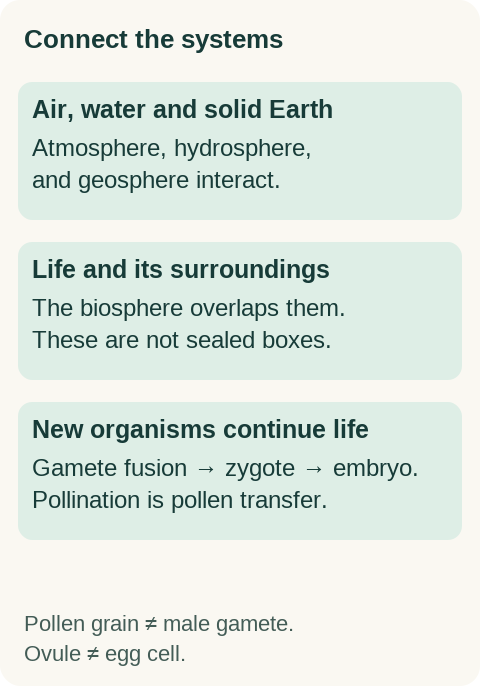
The atmosphere is the gaseous envelope around Earth. The hydrosphere includes water in its different forms and locations. The geosphere includes the solid Earth and its materials. The biosphere includes life and the regions in which organisms live.
These are useful ways to describe connected systems, not sealed containers. A pond has water, gases, mineral material and organisms. Soil contains non-living particles as well as living organisms. Life is found in parts of land, water and air; it is not confined to solid rock just because Earth's crust is thin compared with the planet.
Plants use water and carbon dioxide in photosynthesis, supported by sunlight. Many organisms use oxygen in respiration, while some microorganisms live without oxygen. Decomposers return nutrients from dead matter to the environment. Water transports substances through organisms and landscapes. A change to vegetation can therefore affect food relationships, soil and water at the same time.
Reproduction continues a lineage, not one individual's life
An individual organism does not live forever. Reproduction produces new organisms and allows a lineage to continue. Genetic information helps explain both similarities and differences between parents and offspring.
In asexual reproduction, one parent produces offspring without the fusion of gametes. The offspring are usually genetically very similar to the parent, although changes in genetic material can occur. Vegetative propagation in plants is one example: a new plant can grow from a suitable stem, root or leaf part, depending on the species. Not every piece of every plant can do this.
Sexual reproduction involves the fusion of gametes. In animals, these are sperm and egg cells. Their fusion forms a zygote, which divides and develops into an embryo. Genetic information from both gametes contributes to the offspring. In flowering plants, both kinds of reproductive structures may occur in the same individual, so "sexual" does not always mean two separate individual plants.
Flower structures are not the same as gametes
Keep these stages and structures separate:
- Pollination: pollen is transferred from an anther to a suitable stigma.
- Male gametes: produced in association with the pollen grain; a pollen grain is not simply another name for a sperm cell.
- Female gamete: an egg cell within the structures of an ovule; an ovule is not simply another name for an egg cell.
- Fertilisation: male and female gametes fuse to form a zygote.
The zygote develops into an embryo. In the usual flowering-plant sequence, an ovule develops into a seed and the ovary develops into a fruit. A fruit can therefore contain several seeds, corresponding to several ovules. Pollination and fertilisation are linked, but receiving pollen is not the same event as gamete fusion.
Animals also have different developmental patterns. Birds lay eggs in which developing young are nourished by stored material. Most mammals develop inside the mother's body before birth. Avoid saying that every mammal gives birth to live young or that embryo development in a bird only starts after the egg is laid.
Variation does not mean choosing a needed trait
Offspring can differ in inherited characteristics. Across generations, some inherited differences affect survival and reproduction in a particular environment. This can change populations over time.
An individual does not deliberately create an inherited feature because it needs one. Likewise, antibiotic resistance is not bacteria deciding to improve themselves. The health chapter's example connects inherited variation and selection with the survival of resistant bacteria. Reproduction and inheritance help explain continuity and change without treating evolution as a planned journey towards perfection.
Protect the connections, not only one symbol
Climate change, biodiversity loss and pollution are linked threats. Burning fossil fuels adds carbon dioxide to the atmosphere. Increased greenhouse-gas concentrations alter Earth's energy balance. Habitat destruction removes places organisms need, while pollutants can affect air, soil, water and food relationships.
The natural greenhouse effect is necessary for familiar conditions on Earth; the problem is not that all greenhouse gases are harmful and should disappear. The problem includes the additional warming caused by human-driven increases in their concentrations.
The Paris Agreement's temperature aim is to hold warming well below 2 degrees Celsius above pre-industrial levels and pursue efforts to limit it to 1.5 degrees Celsius. That is an international goal, not a prediction or a claim that each location warms by the same amount.
Protecting habitats, using resources carefully, reducing pollution, saving energy and repairing or reusing materials address different parts of the problem. Individual actions matter alongside decisions by communities, businesses and governments. One token action does not cancel every other impact.
Check your reasoning
- Does being in a habitable zone prove a planet has life?
- Which is more directly associated with absorbing harmful ultraviolet radiation: stratospheric ozone or the magnetic field?
- Are a pollen grain and a male gamete identical terms?
- Is pollination the same event as fertilisation?
- Does asexual reproduction require every offspring to be an absolutely unchanged copy forever?
- Does reproduction make the parent organism immortal?
Answer check: (1) No; other conditions and evidence are needed. (2) Stratospheric ozone. (3) No. (4) No; pollen transfer and gamete fusion are different events. (5) No; offspring are usually very similar, but genetic changes can occur. (6) No; it supports continuity through new individuals.
Open the practice chapter chooser to inspect available sets; a dedicated set for this guide is not verified here.
Sources: NCERT Curiosity, Class 8 Science, Chapter 13, 2026-27 reprint; NCERT Biology: Sexual Reproduction in Flowering Plants for distinctions between pollen, gametes and ovules; NCERT Biology: Morphology of Flowering Plants, sections on ovary, fruit and seed; UNFCCC's Paris Agreement announcement for the temperature goal. Explanations, questions and diagrams are original learning aids, not official exercise solutions or a forecast of future discoveries.
Written by
Evater Team