
From a schoolbag strap to a cyclone
A broad bag strap can feel more comfortable than a narrow one even when the bag has the same weight. The force has not disappeared: it is spread over a larger contact area. That distinction introduces pressure, the starting point of Chapter 6 of NCERT Curiosity, Pressure, Winds, Storms, and Cyclones.
The chapter then connects pressure in liquids and air to wind, thunderstorms and cyclones. Build those links in order. Memorising a cyclone diagram is less useful if you cannot first explain why a pressure difference can move air.
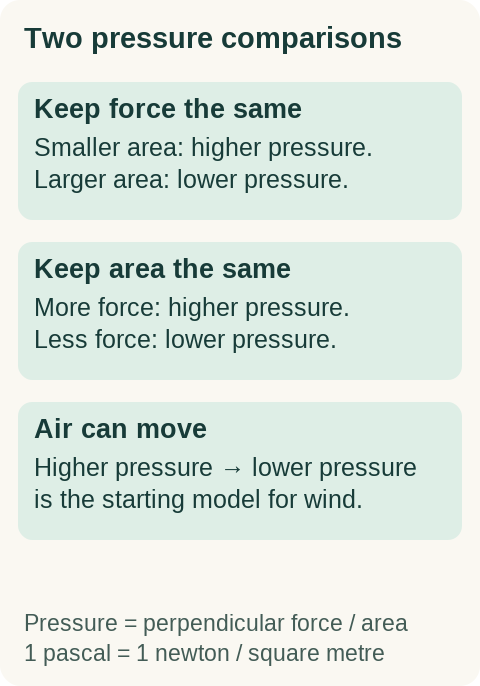
Pressure compares force with area
Pressure = perpendicular force / area. When force is measured in newtons and area in square metres, pressure is measured in newtons per square metre, or pascals (Pa).
Consider an original numerical example. A force of 120 N acts uniformly over 0.06 square metres. The pressure is 120 / 0.06 = 2,000 Pa. Spread the same force over 0.12 square metres and the pressure becomes 1,000 Pa. Doubling area halves pressure only because the force is unchanged.
A sharp point concentrates force over a small area. A broad handle spreads it out. These are explanations, not invitations to experiment with sharp tools. In a numerical answer, write the force, total contact area, substitution and unit. Do not divide by one foot's area when the question says the weight is supported equally on four feet.
Water pushes sideways as well as downwards
Water in a container exerts pressure on its sides and bottom. In the chapter's comparisons with the same liquid, pressure is greater at greater depth below the surface. Two points at the same depth in the same connected, stationary liquid have the same pressure, even if the containers have different widths.
Pressure and total force are not the same quantity. Equal pressure over different bottom areas can produce different total forces. This is why "a wider vessel always has more pressure" is a poor rule.
An overhead tank supplies water with a pressure related to the height of water above the outlet. In an ideal comparison, a lower tap has a greater height of water above it. Real flow also depends on pipes and other losses, so a textbook height comparison is not a promise about every household tap.
Air pressure explains more than wind
Air exerts pressure in all directions. A suction cup sticks when pressure outside it is greater than pressure in the sealed space beneath it. It is not held there by a mysterious pulling substance called suction. A rough surface can let air leak in and reduce the pressure difference.
A pressure difference also helps drive air from a higher-pressure region towards a lower-pressure region. Wind direction in real weather has other influences, including Earth's rotation, but the pressure difference is the key starting idea here.
During a daytime sea breeze, land warms faster than nearby water. Air above the land becomes warmer and rises; cooler air moves in from the sea towards the lower-pressure region. At night, the relative heating pattern can reverse, giving a land breeze. Name both the heating difference and the direction of air movement in your explanation.
Thunder and lightning are different parts of a storm
Rising warm, moist air can cool, allowing water vapour to condense into droplets. Strong upward and downward motions in thunderclouds help separate electric charges. When the electrical conditions overcome air's insulating effect, a discharge produces lightning.
Lightning rapidly heats nearby air, which expands and produces thunder. Lightning is the electrical discharge; thunder is the sound. Do not describe thunder as two clouds simply crashing together.
How a cyclone strengthens
Over warm ocean water, warm moist air rises. As water vapour condenses, it releases heat, helping the rising motion continue. Air moves towards a low-pressure region, and Earth's rotation helps organise the circulation into a spinning system.
The eye of a developed cyclone can be relatively calm, with very low pressure. The surrounding region can have extremely strong winds and heavy rain. A short calm period is not evidence that the cyclone has finished. Hazards include wind, coastal storm surge, heavy rainfall and flooding, not wind alone.
Real storms are not classroom experiments
Use the textbook for the pressure model, but follow official weather warnings and emergency instructions in a real storm. Do not open windows to "balance pressure". Andhra Pradesh's disaster authority advises keeping doors and windows shut, following evacuation directions and waiting for the official all-clear, including after a calm eye passes.
For lightning, move promptly to a substantial building or an enclosed hard-topped vehicle. An isolated tree, open shelter or crouching position outdoors does not make you safe. Indoors, avoid contact with plugged-in electrical equipment and plumbing, and stay away from doors and windows. The US National Weather Service advises waiting 30 minutes after the last thunder or lightning before returning outside. Local evacuation or flood warnings can require staying sheltered longer.
These precautions are not an experiment to try during dangerous weather. Ask a trusted adult to help follow local official instructions.
Check your reasoning
- In the 120 N example, what happens to pressure if area is halved while force stays the same?
- Two water-filled vessels have different widths but the same water depth. Must their bottom pressures differ?
- Why can a suction cup fail on a rough wall?
- During a daytime sea breeze, which way does near-surface air move?
- Why must you not go outside just because the eye of a cyclone feels calm?
Answer check: (1) It doubles. (2) No, for the same stationary liquid at the same depth. (3) Air leakage reduces the pressure difference. (4) From sea towards land. (5) Dangerous winds can return after the eye; wait for official advice.
Practise explanations with units
Make one pressure calculation and one labelled wind explanation before checking the answers. The practice chapter chooser shows currently available sets; a dedicated set for this guide is not verified here.
Sources: NCERT Curiosity, Chapter 6, 2026-27 reprint; Andhra Pradesh State Disaster Management Authority cyclone guidance; US National Weather Service lightning safety and why crouching is not protection. Real-world safety advice above follows the specialist guidance where a simplified textbook passage differs. Examples and questions are original, not official exercise solutions.
Written by
Evater Team