
Appearance is not enough to classify matter
Air, water and iron can all look uniform, but they do not belong to the same category. Air is a mixture, pure water is a compound and iron is an element. Chapter 8 of NCERT Curiosity, Nature of Matter: Elements, Compounds, and Mixtures, explains why looking for visible pieces is only a starting point.
The better questions are: Is there one substance or more than one? Are different elements chemically combined? Can the components be separated by a physical process? Use these questions together rather than guessing from colour or texture.
A mixture keeps more than one substance together
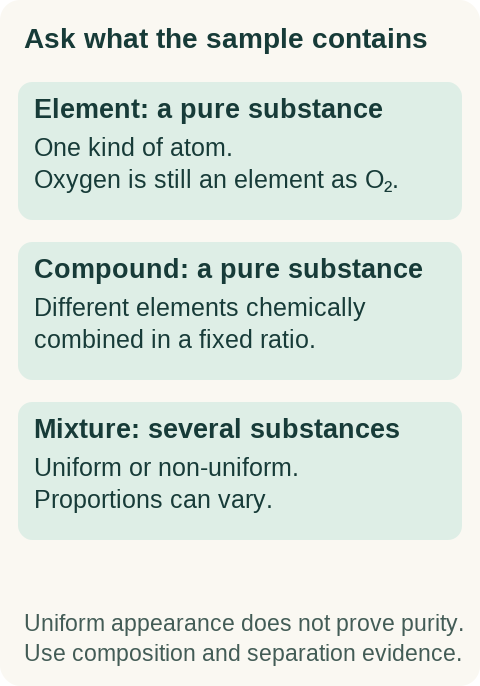
A mixture contains two or more substances as components. Forming the mixture does not itself make those components into a new compound. Their proportions can vary: one glass of sugar solution may contain more sugar than another.
In a non-uniform mixture, the composition is not the same throughout. Sand and water are an example. In a uniform mixture, components are distributed evenly, as in a properly mixed sugar solution. Separate components need not be visible for a sample to be a mixture.
Air is a mixture of gases, not one gas called "air". Alloys such as brass and bronze are mixtures too. Their usefulness does not make them elements. Brass contains copper and zinc; bronze contains copper and tin. The chapter also describes stainless steel as an alloy.
Scientific purity is different from a food label
In everyday language, "pure milk" can mean milk without an adulterant. In science, milk is still a mixture. The word "pure" on a package does not establish that its contents are one chemical substance.
A pure substance has a definite composition and cannot be separated into different substances by physical separation methods. Both elements and compounds can be pure substances. Therefore, "pure substance" is not another name for "element".
For comparison, pure sugar is a compound, while sugar dissolved in water is a mixture. Adding water has not turned sugar into an element. It has produced a sample containing more than one substance.
An element contains one kind of atom
Iron, gold, sulfur and oxygen are examples of elements. An element cannot be broken down into simpler substances by chemical reactions. Each element has its own kind of atom.
An element need not consist of separate, unjoined atoms. Oxygen gas has molecules containing two oxygen atoms. It is still an element because only one kind of atom is present. The number of atoms joined together and the number of different elements are different questions.
Some elements are metals, such as iron and aluminium; others are non-metals, such as sulfur and oxygen. Do not use "metal" and "element" as interchangeable words.
A compound has a fixed chemical composition
A compound forms when different elements combine chemically in a fixed ratio. Water contains hydrogen and oxygen, with two hydrogen atoms for each oxygen atom in a water molecule. A mixture of hydrogen and oxygen gases is not the same substance as water.
The properties of a compound can differ greatly from those of its constituent elements. Oxygen supports burning, and hydrogen is a fuel, but their combination as water has different properties. Do not predict a compound's behaviour by simply adding together descriptions of its elements.
Common salt, sodium chloride, is also a compound. Its sodium and chlorine are chemically combined. Evaporating water from a salt solution separates salt from water; it does not separate sodium chloride into sodium and chlorine.
Physical separation is not chemical breakdown
NCERT contrasts a mixture of iron and sulfur with the new substance formed when they react on heating. In the mixture, a magnet can separate the iron. After a suitable chemical reaction, iron sulfide has different properties; a magnet does not simply separate it back into the starting materials.
The reasoning depends on a new substance forming, not on the mixture merely changing shape. Melting or freezing water is a physical change; chemically breaking water into hydrogen and oxygen is a different process.
Study the observations in a prepared diagram or a teacher-led lesson. Do not heat sulfur, add acids to unknown samples, prepare gases, smell reaction products or test gases with a flame at home. Classification questions do not require reproducing hazardous laboratory demonstrations.
Minerals connect the categories to Earth
Rocks commonly contain mixtures of minerals. Many minerals are compounds, while native minerals can be elements, such as gold. "Mineral" describes a naturally occurring material category; it is not a third alternative that replaces element or compound in every question.
A useful explanation can therefore use more than one classification: native gold can be both a mineral and a metallic element. Those labels answer different questions. Do not conclude that every mineral is an element, or that every rock is one pure substance.
Check the reason, not only the label
- A sample looks uniform. Is that enough to call it a pure substance?
- Oxygen molecules contain two atoms. Why is oxygen still an element?
- Is pure sugar an element, a compound or a mixture?
- Does evaporating a salt solution produce separate sodium and chlorine?
- Why can "gold is a mineral" and "gold is an element" both be correct?
Answer check: (1) No; uniform mixtures exist. (2) The atoms are of the same element. (3) A compound. (4) No; it separates salt from water, not salt into its elements. (5) Mineral occurrence and chemical classification are different questions.
Build a classification with evidence
Choose three examples and write the category plus one reason. A label without a reason is easy to guess and easy to forget. The practice chapter chooser shows available sets; a dedicated practice set for this guide is not verified here.
Source: NCERT Curiosity, Class 8 Science, Chapter 8, 2026-27 reprint. This guide uses original explanations, diagnostics and a diagram, not official exercise solutions or home chemistry instructions.
Written by
Evater Team