
A model for things too small to see
Grinding chalk makes smaller pieces of chalk, not a new substance. Dissolving sugar makes its crystals disappear from view, but does not mean that the sugar has ceased to exist. Chapter 7 of NCERT Curiosity, Particulate Nature of Matter, uses observations like these to develop a particle model.
The model connects three ideas: the spacing between particles, their attraction to one another and their motion. Use those ideas to explain what a substance does, rather than drawing the same group of dots under three different labels.
A grain is not one constituent particle
A visible grain of sugar or a speck of chalk contains an enormous number of much smaller constituent particles. These are too small to see with an ordinary microscope. A diagram with a few large circles is a model, not a photograph or a life-size view.
The word "particle" depends on context. Dust particles in air are tiny pieces of material, but each dust particle itself contains many constituent particles. Do not confuse a visible speck of dust with one atom or molecule.
When sugar dissolves, its constituent particles spread among water particles. The sugar remains part of the solution even when separate grains are no longer visible. This explains disappearance from view without inventing disappearance of matter. Never taste an unknown solution or any laboratory material to test that claim.
Solids vibrate without flowing
A solid has a definite shape and volume under ordinary conditions. Its particles are held close together by attractions and vibrate about their positions. They are not completely motionless, but they do not move past one another freely as particles in a liquid can.
A common trap is rice or flour in a jar. The pile takes the jar's shape because many solid grains can move around one another. Each grain is still a solid. The flow of a collection of grains does not prove that the material has become a liquid.
Liquids change shape, not their amount
A liquid takes the shape of the part of a container it occupies while keeping a definite volume under the same conditions. Its particles remain close together but can move past one another. The attractions are strong enough to keep the liquid together without holding every particle in a fixed position.
Imagine transferring 200 mL of water from a narrow vessel into a wider one without spilling. Its level becomes lower, but its volume is still 200 mL. Height and volume are different. Spillage or water left on the first vessel can change the measured amount, so observations still need care.
Gases fill the available space
Gas particles are much farther apart and move freely in different directions. A gas has no fixed shape or fixed volume of its own: it spreads to fill the available container.
A gas is also much easier to compress than a liquid. In a sealed comparison, compression brings particles closer together. It does not mean the individual particles are being squashed into smaller versions of themselves. Liquids are practically incompressible in the simple classroom comparison because their particles are already close together.
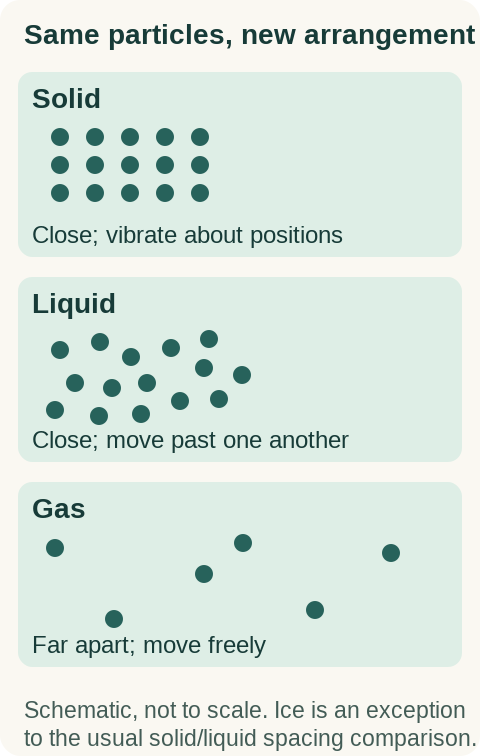
The diagram is schematic and not to scale. The same-size dots emphasise arrangement and spacing, not a claim that particles grow when a substance changes state. The familiar "solid closer than liquid" comparison has exceptions: ice has a more open arrangement than liquid water.
Heating changes motion and can change state
Heating generally increases particle motion. In a solid, vibrations become more vigorous. At melting, the arrangement changes so particles can move past one another. A liquid can become a gas when particles separate enough to move freely through the available space.
During a change of state, energy helps overcome attractions. Do not say that adding heat always raises temperature continuously, or that melting turns the constituent particles themselves into liquid droplets. The state describes the substance's collective arrangement and behaviour.
Evaporation and boiling are related but different. Evaporation occurs at the liquid surface and can happen below the boiling point. At boiling, vapour forms rapidly throughout the liquid as well as at its surface. A puddle drying on a cool day is not proof that it reached its boiling point.
Spreading is evidence, not a close-up film
A coloured substance can spread through water without stirring, and gas particles can mix through motion. The model explains these changes using moving particles. Temperature and bulk movement of the fluid can affect how quickly a visible colour spreads; a kitchen observation is not a precise measurement of an individual particle's speed.
Use prepared images or teacher-led demonstrations. You do not need to burn incense, inhale smoke, handle iodine or potassium permanganate, heat sealed vessels or use a syringe needle to revise this chapter. Drawing a labelled model and predicting an observation can test the explanation without introducing those hazards.
Check your understanding
- Why is a grain of sugar not one constituent particle?
- Correct the statement: "Particles in a solid do not move at all."
- A fixed amount of liquid is poured into a wider vessel. Must its volume increase?
- When trapped air is compressed, do its particles become smaller or closer together?
- Is water evaporating from a wet cloth necessarily boiling?
- Why should a particle diagram keep the dots the same size during a change of state?
Answer check: (1) A grain contains many much smaller constituent particles. (2) They vibrate about their positions. (3) No; the shape and level can change without a volume increase. (4) Closer together. (5) No; evaporation can occur below the boiling point. (6) The model shows changes in arrangement, spacing and motion, not particle growth.
Turn observations into explanations
Choose a solid, liquid and gas. For each, describe shape, volume, spacing and movement, then connect those properties in a sentence beginning "because". Open the practice chapter chooser to inspect available sets; a dedicated practice set for this guide is not verified here.
Source: NCERT Curiosity, Class 8 Science, Chapter 7, 2026-27 reprint. The comparisons, questions and diagram here are original learning aids, not official exercise solutions. The particle model is a simplified explanation for this level, not a scale drawing of atoms or molecules.
Written by
Evater Team