
One circuit can produce more than one effect
A wire carrying electric current can affect a nearby magnetic compass and become warm. These are not competing explanations. They are two effects of current: the magnetic effect and the heating effect.
Chapter 4 of NCERT Curiosity, Electricity: Magnetic and Heating Effects, connects these observations to electromagnets, household heating devices and the chemical sources that power a circuit. The useful question is not only "Which device uses electricity?" but "What changes, and how does current help cause that change?"
A compass can detect a magnetic effect
A compass needle is a small magnet. In a teacher's demonstration, a nearby wire carrying current can deflect it. When the current stops, the magnetic field produced by that current disappears, and the needle can return towards its original direction.
The observation is the needle moving. The explanation is that current in the wire produces a magnetic field around it. The wire does not need to be made of iron for current to have a magnetic effect. Do not confuse a magnetic material with a current-carrying conductor.
A compass that fails to show an obvious deflection does not, by itself, prove that there is no current. Position, distance and the size of the effect matter. A useful investigation changes one condition at a time and checks the circuit as well as the observation.
Turn a coil into a controllable magnet
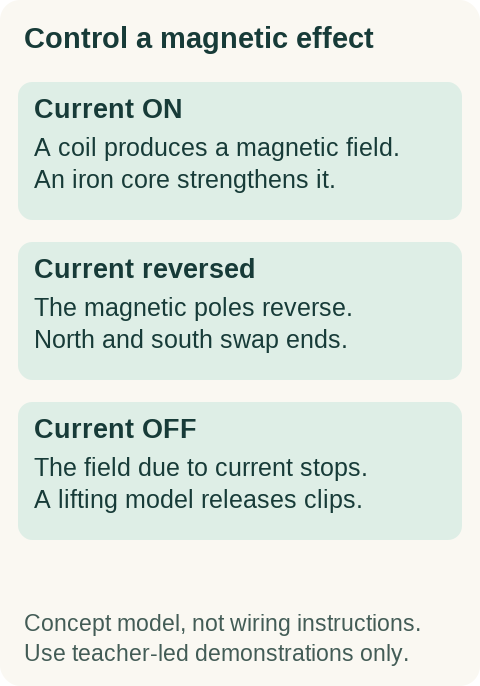
A coil carrying current behaves like a magnet. An iron core inside it makes the magnetic effect stronger in the chapter's comparison. This is an electromagnet: its operation can be controlled by switching the current.
In the lifting model, current is switched on, iron clips are attracted, and switching off releases them. In real applications, lifting electromagnets help move suitable iron and steel objects. They do not attract every metal simply because it is a metal.
An electromagnet has north and south poles. Reversing the direction of current reverses those poles. Removing an iron core does not remove the coil's magnetic effect altogether; a current-carrying coil can still deflect a compass, although the effect is weaker in the comparison described here.
To compare coil designs fairly, keep other conditions as similar as possible. More turns or a change in current can change the strength, but changing the core, battery and number of turns together makes it hard to identify which change mattered.
Heating is an energy change
A conductor offers resistance to current. As current passes through it, electrical energy can be transferred as heat. This is useful in the heating element of an electric iron or kettle, but unwanted heating in wiring can waste energy and become dangerous.
The chapter compares nichrome with copper of the same size and length. They do not offer the same resistance. The heating of a wire also depends on its dimensions, the current and the time for which current flows. A fair comparison must say what is being kept the same.
Do not memorise "a thicker wire always gets hotter" or "a longer wire always gets hotter" without a stated circuit and comparison. Changing a wire can also change the current. At this level, focus on the energy change and the factors, rather than inventing an unconditional rule.
A cell uses a chemical reaction
An electric cell is not a store of current waiting to spill out. Chemical reactions inside it supply electrical energy to a connected circuit. A simple voltaic cell has two different metal electrodes and an electrolyte. The electrolyte allows the cell to work as part of the circuit.
NCERT describes a lemon-cell model with copper and iron electrodes. The lemon juice is the electrolyte; it is not enough to attach any two identical pieces of metal to a fruit and assume the same result. An LED also has to be connected with the correct polarity. One unsuccessful LED observation is not a complete diagnosis of the cell.
The dry cell described in the chapter has a moist paste electrolyte, despite the name "dry". That single-use cell must not be recharged. Other batteries are designed to be rechargeable, but they also wear out with repeated use. Follow the battery and charger instructions, not an improvised classroom charging method.
Keep the explanation, not the hazard
Use diagrams or teacher-led, low-voltage demonstrations for revision. Never connect classroom wires to mains sockets, deliberately heat or touch a wire, short a cell, open a battery or try to recharge a single-use cell. Even a low-voltage cell and wire can become hot. Used batteries need an appropriate collection or recycling route, not dismantling at home.
Check your reasoning
- A student removes the iron core but leaves current flowing through the coil. Must the compass stop responding?
- Why does switching off a lifting electromagnet help release iron clips?
- Which change reverses an electromagnet's poles: reversing current or simply adding an iron core?
- An electric kettle gets hot. Name the energy change and the effect of current involved.
- Why is "dry cell" not the same as "a cell containing no moisture"?
Answer check: (1) No. The current-carrying coil still has a magnetic effect; the core strengthens it. (2) The magnetic field produced by the current disappears when current stops. (3) Reversing current. (4) Electrical energy is transferred as heat through the heating effect. (5) The electrolyte in the cell described is a moist paste.
Practise the cause-and-effect links
For each device, write: source of energy, effect of current, useful result and one safety boundary. Then open the chapter practice chooser to see the available sets. A dedicated practice set for this guide is not verified here.
Source: NCERT Curiosity, Class 8 Science, Chapter 4, 2026-27 reprint. Questions and diagrams here are original learning aids, not official exercise solutions or instructions for electrical repairs.
Written by
Evater Team