What this chapter covers
Chapter 5 of the new Class 8 Science textbook (Curiosity) starts with two friends cycling against the wind, up a rough hill road, and rolling back down without pedalling. Every part of that ride is a force question. The chapter builds the idea of force, what forces do, the main types, weight, and why things float or sink.
Force in one line
A force is a push or a pull that comes from one object interacting with another. It is measured in newtons, written N.
No interaction, no force. When you push a table, your hand and the table are two objects interacting. The moment you stop pushing, the force between them is gone.
What a force can do
- Make a resting object move, like a football when you kick it.
- Change the speed of a moving object, like brakes slowing a bicycle.
- Change the direction of motion, like a bat turning a moving ball.
- Change the shape of an object, like pressing an inflated balloon.
Contact and non-contact forces
Contact forces need touching surfaces: muscular force (your legs pedalling) and friction are the chapter's examples. Non-contact forces act at a distance: magnetic force, electrostatic force (a rubbed balloon attracting paper bits), and gravitational force (what pulls you downhill on that bicycle without pedalling).
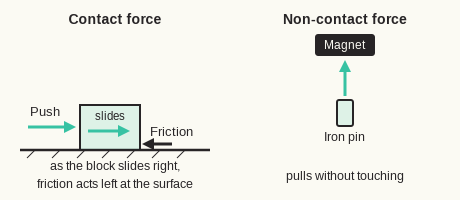
Friction, the force students misread most
Friction acts whenever two surfaces slide, or try to slide, against each other, and it points opposite to that sliding. It comes from tiny irregularities in the two surfaces locking into each other, which is why friction is greater on rough surfaces and why a wet, smooth floor is slippery. Friction is not only a solids thing: water and air also resist motion, which is why aeroplanes, ships and high-speed trains are built with shapes that reduce it. And friction is not a villain: without it you could not walk, write, or hold this book.
Weight, floating and sinking
Weight is the force with which the Earth pulls an object, and it is measured with a spring balance in newtons. The chapter closes with floating and sinking: whether an object floats depends on how its weight compares with the push it gets from the liquid around it.
Common confusions to clear early
- "An object at rest has no force on it." Usually it has several forces balancing each other out.
- "Friction always slows things down, so it is bad." It also makes walking, gripping and writing possible.
- "Heavier objects always sink." Floating depends on the push from the liquid too, not weight alone.
How to practise this chapter
After each section, list three everyday examples of the idea from memory, then check the book. For friction, explain the bicycle story to someone else: uphill pedalling, the rough road, the wet patch, the freewheel downhill. Evater practice tests can help you turn chapter reading into an attempt-and-feedback loop, free to try.
Explore with a 3D block
Two pushes. One net force.
Change the pushes on opposite sides of the same block. Compare the arrow lengths, then work out the horizontal net force.
Take right as positive: 6 - 4 = 2 N.
2 N to the right.
This net force changes the block's motion. Its direction is not necessarily the direction the block is already moving.
Simplified model: both pushes act on one rigid block along a horizontal line. Friction and turning are ignored; weight and support balance vertically. This is a force diagram, not a prediction of speed or distance.
Try equal pushes, then change just one. Zero net force means no change in motion, not necessarily no motion.
Written by
Evater Team