
What this chapter covers
Chapter 10 of the new Class 8 Science textbook (Curiosity) is about how light behaves when it bounces off surfaces and when it passes through curved glass. That means mirrors (plane, concave and convex), lenses (convex and concave), and the diagrams that explain where images form. Most of the marks in this chapter come from understanding a small set of ideas clearly and drawing them correctly.
Start with how you see anything at all
Light from a source hits an object, bounces off it, and some of that light enters your eyes. You see the object because of reflected light. Keep this picture in mind: every idea in the chapter is a version of it.
The laws of reflection
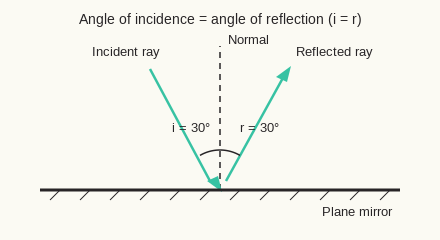
The angle of incidence always equals the angle of reflection, and both are measured from the normal.
The normal is an imaginary line drawn perpendicular to the mirror exactly where the light ray hits it. When a question gives you a ray hitting a mirror, your first move is always the same: draw the normal. Measure from the normal, never from the mirror's surface.
Regular and diffused reflection
A smooth surface, like a mirror or still water, reflects parallel rays in one direction, so you see a clear image. A rough surface, like a wall or a page, scatters the rays in many directions, so you see the object but no image. This is why you can see your face in a steel spoon but not in a notebook.
Plane mirror images
An image in a plane mirror is the same size as the object, appears the same distance behind the mirror as the object is in front, and is laterally inverted: left and right are swapped. That is why AMBULANCE is written in reverse on the front of the vehicle, so drivers ahead can read it correctly in their rear-view mirror.
Curved mirrors: concave and convex
- A concave mirror curves inward, like the inside of a spoon. It brings light rays together, which is why torch headlights and shaving mirrors use it.
- A convex mirror bulges outward, like the back of a spoon. It spreads light rays apart and shows a wider area, which is why it is used as a rear-view mirror in vehicles and a security mirror in shops.
Lenses: convex and concave
A convex lens is thicker in the middle and brings light rays together. A magnifying glass and a camera lens are convex lenses. A concave lens is thinner in the middle and spreads light rays apart; spectacles for short-sightedness use concave lenses. The easy memory hook: concave caves in at the middle.
Diagrams do the learning
Most students lose marks in this chapter on diagrams, not definitions. The fix is retrieval drawing: read one ray diagram, close the book, redraw it from memory with labels, then compare with the textbook. Repeat until the drawing comes out right the first time. Ten minutes of this beats an hour of staring at the printed figure.
Common confusions to clear early
- Mixing up which one converges and which one diverges. Concave mirror and convex lens bring rays together; convex mirror and concave lens spread them apart.
- Thinking lateral inversion flips everything. A plane mirror swaps left and right only, never up and down.
- Assuming a magnified image means a bigger object. The object stays the same size; the lens changes how the light reaches your eye.
How to practise this chapter
After each section, answer a short set of questions from memory before rechecking the book. Record why each wrong answer went wrong: concept gap, misread diagram, or a missing label. Evater practice tests can help you turn chapter reading into an attempt-and-feedback loop, free to try.
Written by
Evater Team