Health is more than the absence of disease
Health: The Ultimate Treasure, Chapter 3 of NCERT Curiosity, connects physical, mental and social well-being. Food, sleep, movement, feelings, relationships and surroundings all matter. Someone can need support even when they have no obvious injury or fever.
This is a school Science guide, not a diagnosis or treatment plan. If you feel unwell or worried, tell a trusted adult and seek advice from a qualified health professional. Do not choose medicines from a study guide.
Signs and symptoms: what is the difference?
A symptom is something a person experiences, such as pain or dizziness. A sign can be observed or measured, such as a rash or a high temperature measured with a thermometer.
These clues help a clinician investigate what is wrong. One clue does not identify a disease by itself. A headache, for example, is not enough evidence to conclude that someone has a particular infection.
Communicable does not mean every disease
Communicable diseases can spread through pathogens. A pathogen is a disease-causing agent, such as a bacterium, virus or certain other organisms. Non-communicable diseases do not pass from one person to another through ordinary contact. Asthma and diabetes are examples used in the chapter.
Do not confuse a cause with a route of spread. The dengue virus is a pathogen; a mosquito can carry and transmit it. The mosquito is the vector, not the virus itself.
Non-communicable does not mean unimportant, easy to cure or always caused by someone's choices. Health has many influences. People with any illness deserve care and respect, not blame.
Match prevention to the route
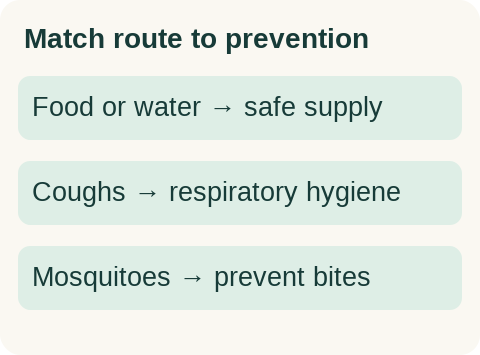
Different routes call for different precautions. Safe drinking water, sanitation and properly handled food help reduce infections spread through contaminated food or water. Handwashing and covering coughs and sneezes help reduce some routes of spread. Preventing mosquito breeding and using suitable protection reduce exposure to mosquito bites.
Think in links: source of exposure → route into the body → a step that interrupts that route. One precaution is not a complete shield against every disease. Clean drinking water, for example, does not replace mosquito control.
Community conditions matter as well as personal habits. Waste collection, clean air, safe water and supportive schools help people protect their health. Prevention is not only an individual's responsibility.
Immunity and vaccines
The immune system helps defend the body against pathogens. Vaccines train immune responses against particular diseases. They can prepare the body to recognise a pathogen or part of it, so it can respond more effectively later.
Vaccines and medicines have different jobs. In this chapter, vaccination is prevention, not a cure for an existing illness. Vaccines do not all use the same method: the chapter describes weakened or inactivated pathogens, harmless components and newer approaches. Follow qualified health advice about vaccination rather than trying to decide a schedule from a textbook.
Antibiotics are not a cure for every infection
Antibiotics can treat certain bacterial infections. They do not treat viral infections such as the common cold or flu. A clinician decides whether an antibiotic is needed and which treatment is suitable.
Antibiotic resistance means bacteria can survive medicines that previously worked against them. It is not a person's body "getting used to" an antibiotic. Unnecessary use and incorrect use can contribute to the problem. Take antibiotics only when prescribed, and follow the prescriber's instructions about dose and duration. Do not share them or use leftover medicines.
Build an explanation, not a memorised slogan
Consider a school that has clean drinking water but containers of stagnant water outdoors. A student says, "No one here can get dengue because our drinking water is clean."
The claim mixes up two routes. Safe drinking water helps prevent some infections, but dengue spreads through infected mosquito bites. Checking and addressing mosquito breeding sites is a different prevention task. The answer needs the route of spread, not just the slogan "keep clean".
Check your understanding
- Is dizziness reported by a student a sign or a symptom?
- In mosquito-borne dengue, identify the pathogen type and the vector.
- Why is an antibiotic not a suitable automatic response to the common cold?
- A student has no fever but feels isolated and persistently distressed. Which wider idea of health should the school remember?
- Does non-communicable mean that a disease is harmless?
Answer check: (1) A symptom. (2) A virus is the pathogen; the mosquito is the vector. (3) Colds are viral; antibiotics do not treat viruses. A clinician should guide treatment. (4) Mental and social well-being matter as well as physical well-being. (5) No. The term describes spread, not seriousness.
Practise the links
Make a three-column revision sheet: disease or situation, route or cause, and a relevant prevention step. Keep diagnosis and treatment decisions for health professionals. Open the chapter practice chooser to see the available sets; a dedicated practice set for this article is not verified here.
Source: NCERT Curiosity, Class 8 Science, Chapter 3 (2026-27 reprint). Examples and answer checks here are original learning aids, not a medical protocol or official exercise solutions.
Written by
Evater Team