
Start with a question you can investigate
Curiosity Chapter 1, Exploring the Investigative World of Science, is an invitation to work like an investigator. It introduces the journey through the Class 8 Science book, from cells and health to electricity, matter, the skies and Earth. Its main lesson is a way of finding out, not a list of facts to memorise.
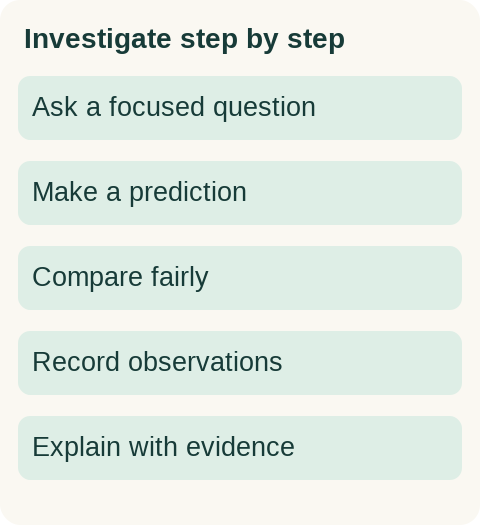
A useful investigation connects a focused question, a fair comparison, careful observations and an explanation that fits the evidence. You may need to change your explanation when new evidence appears.
Turn a broad question into a focused one
"How does the world work?" is interesting but too broad for one classroom investigation. "Does changing the size of a paper spinner affect how long it takes to fall?" tells you what to change and what to measure.
Before testing, write a prediction and your reason. A prediction is what you expect to happen. An observation is what you actually notice or measure. They can disagree. That disagreement is a reason to investigate further, not to rewrite your results.
Change one thing, measure another
For a teacher-approved paper-spinner comparison, imagine testing two spinner sizes while keeping the paper type, overall design, drop height and release method the same. Drop only from a safe, low height while standing on the floor, away from people and obstacles. Do not climb on furniture.
- Change: the spinner size. This is the factor you are testing.
- Measure: the time from release to reaching the floor, in seconds.
- Keep the same: the other conditions that could affect that time.
If you change the paper type and drop height as well as the size, a different falling time cannot be confidently explained by size alone. A fair comparison reduces these competing explanations.
Record results before deciding what they mean
Suppose a class records the following made-up results. These are an example for reasoning, not measurements from an experiment Evater conducted.
- Small spinner: 1.2 s, 1.3 s, 1.1 s.
- Large spinner: 1.6 s, 1.5 s, 1.7 s.
In these trials, the larger spinner took longer to fall. Repeating the comparison helps show whether a pattern is consistent, rather than depending on one unusual release or a timing mistake. It does not prove that every large spinner always falls more slowly in every condition.
A careful conclusion is: "With the design, paper and drop height used here, the larger spinner took longer in our three trials." A new question could be whether changing the paper type changes that pattern.
Observation and explanation are different
"The spinner took 1.6 seconds to reach the floor" is a measurement. "Air affected its motion" is an explanation to explore. Do not treat an explanation as something directly seen on a stopwatch.
NCERT uses the puffing of a puri to show how an everyday observation can lead to questions about conditions, measurements and fair comparisons. Hot oil is dangerous: this is not a suggestion to fry food as an unsupervised student experiment. You can practise the same reasoning with safe, teacher-approved materials.
See the connections across this book
The chapter previews links between topics. Microbes connect to food and health. Electricity connects to heating and magnetism. Forces connect to pressure and weather. The particle model helps explain materials and solutions. Light, the Moon and calendars connect observations on Earth with the sky. Ecosystems and climate connect living things with their surroundings.
Use these links as questions to return to as you study. Chapter 1 is an overview, not a substitute for the explanations in the later chapters.
Check your reasoning
- A student changes spinner size and paper type together. Why is the comparison hard to interpret?
- A prediction says a spinner will fall faster, but the measurements show a longer falling time. Which should the conclusion follow?
- Why record several trials rather than keeping only the result that matches the prediction?
- Rewrite "big spinners always fall slowly" as a conclusion limited to the example data.
Answer check: (1) Either changed factor, or their combination, might explain the difference. (2) Follow the evidence and reconsider the prediction. (3) Repeated observations reveal variation; selecting only favourable results hides it. (4) "The larger spinner took longer in these trials under the conditions used."
Your next step
Write one safe, focused question of your own. Identify what you would change, measure and keep the same before you begin. Ask your teacher to check the plan. For chapter revision, open the practice chapter chooser; a dedicated practice set for this guide is not verified here.
Source: NCERT Curiosity, Class 8 Science, Chapter 1 (2026-27 reprint). The spinner example and questions above are original practice, not official NCERT exercise answers.
Written by
Evater Team