
You do not need to see an organism with your unaided eyes for it to affect the world around you. Microorganisms help explain changes as different as dough becoming fluffy and fallen leaves breaking down.
The chapter asks you to connect two scales: the small structures that make up living things, and the changes those living things produce.
A microscope changes what you can observe
A microscope helps us examine structures too small to see clearly without magnification. An enlarged view is evidence to describe carefully, not an excuse to guess every object's identity.
When studying a prepared image, separate an observation from an interpretation. "I can see several small rounded structures" describes the image. "Those structures must be a particular bacterium" needs further evidence.
Cells are the building units, but not every cell looks alike
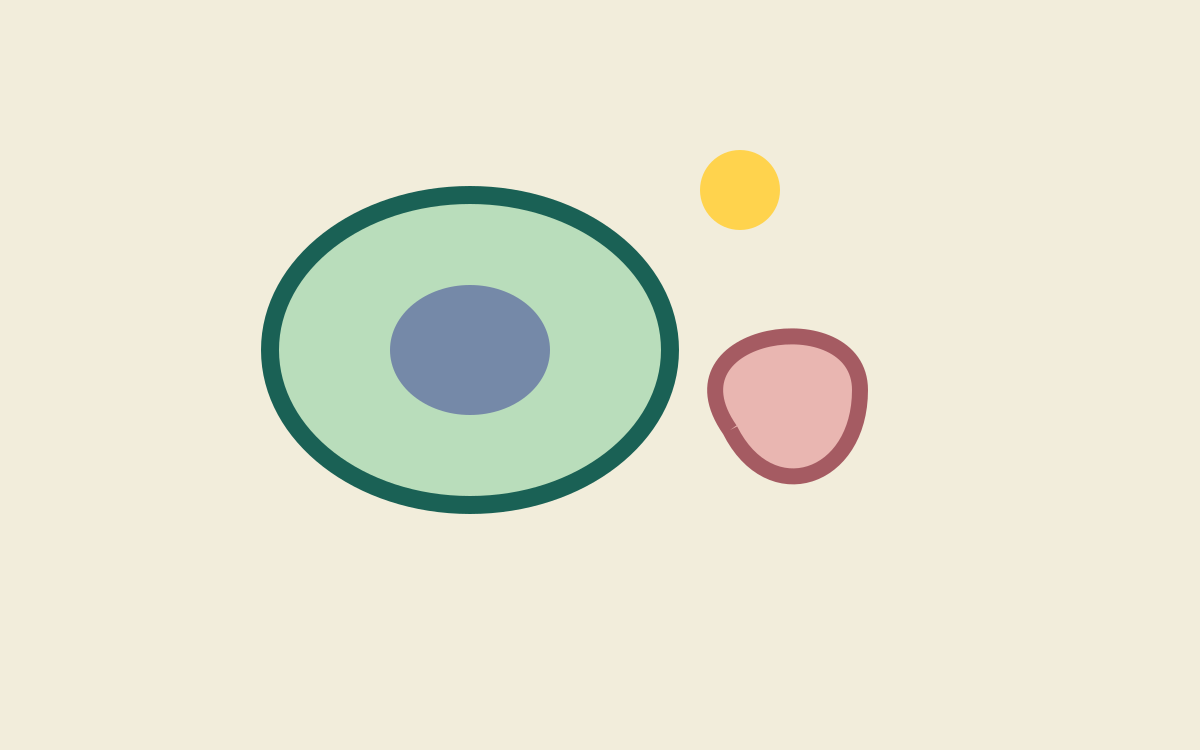
A typical plant or animal cell has a cell membrane, cytoplasm and a nucleus. Do not turn that useful starting picture into a claim that every kind of cell has an identical structure. Bacteria do not have a well-defined nucleus enclosed by a nuclear membrane.
Plant cells also have a cell wall outside the cell membrane. Fungal and bacterial cells have walls too, so a wall is not a feature found only in plants. Chloroplasts help photosynthetic plant cells make food; fungal cells do not have chloroplasts.
A diagram is easier to remember when each label has a job. Ask what forms the boundary, what fills the cell, and where the genetic material is located. Then check which features differ across the examples.
From cells to a whole organism
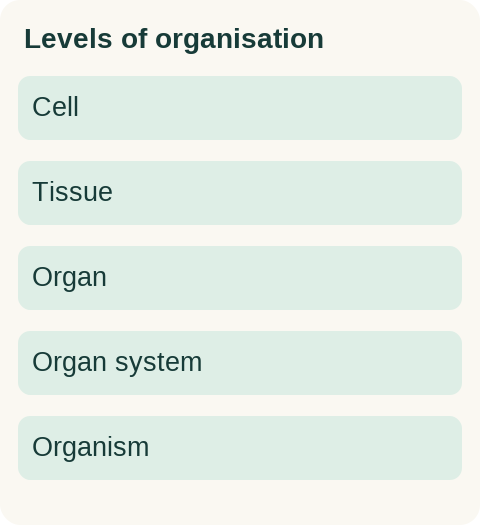
In a multicellular organism, similar cells form tissues. Different tissues make up an organ; organs work together in organ systems. These systems are part of the whole organism. A cell, tissue and organ are different levels, not alternative names for the same structure.
A nerve cell has a long, branched shape suited to carrying messages across the body. A muscle cell can contract and relax. The point is not that every cell has the same shape, but that structure is related to function.
One cell or many cells?
An organism can be unicellular, with one cell, or multicellular, with many cells. Bacteria and protozoa are unicellular. Fungi include both unicellular and multicellular forms. So "microorganism" and "single-celled organism" are not interchangeable labels.
Viruses are a separate case in this chapter: they are acellular and multiply inside living host cells. Do not draw a virus as a miniature bacterial cell with the same parts.
Helpful microbes: explain the change, not only the name
Yeast is a fungus. When yeast breaks down food in dough, carbon dioxide is released. Gas bubbles help make the dough soft and fluffy. The explanation needs the link between a microorganism's activity and the visible change.
Lactobacillus bacteria help with curd formation. Some microorganisms also live in the root nodules of leguminous plants and help bring nitrogen from the air into the soil system. These are reasons why "all microbes are harmful" is a poor rule.
Read an experiment as a comparison
Imagine two teacher-prepared dough samples made with the same flour, water and sugar, kept for the same time in the same warm conditions. Only one has added yeast. If that sample becomes more expanded, the comparison supports an explanation involving yeast activity. Changing the temperature as well would make the cause harder to isolate.
The important chain is yeast uses food → carbon dioxide is released → bubbles become trapped → the dough expands. "Yeast makes dough rise" names a result; the chain explains it. This is a reasoning example, not an instruction to taste experimental dough or grow unknown microbes. Use teacher-prepared images or supervised demonstrations; do not open, smell closely or taste mouldy food.
Microalgae connect sunlight with aquatic life
Microalgae can make food using sunlight. They also release oxygen and provide food for many aquatic organisms. Their small size does not make their ecological role small. Keep this separate from fungi, which do not have chloroplasts and do not make food by photosynthesis.
Decomposition returns nutrients to the environment
Some bacteria and fungi break complex material in dead plants and animals into simpler substances. Nutrients return to the surroundings and can support plant growth. This process is decomposition.
Imagine comparing a sealed display model of a leaf with the leaf material in a managed compost system. The model is an illustration; the decomposition is a process involving living organisms and suitable conditions. A useful answer explains the process, rather than saying the waste simply "vanished".
Check your understanding
- Explain why a microorganism need not be unicellular.
- Name one important difference between a bacterial cell and a typical plant or animal cell.
- Connect yeast activity to a visible change in dough.
- Explain where nutrients can go when fallen leaves decompose.
- Replace "all microorganisms cause disease" with a more accurate statement.
Answer check: some fungi are multicellular; bacteria lack a well-defined membrane-bound nucleus; gas bubbles from yeast activity help dough rise; decomposition returns nutrients to the environment; some microbes are helpful and some can be harmful.
Practise after reading
Sketch a typical plant cell, animal cell and bacterium. Explain a difference rather than copying three identical circles with different labels. Then use the questions above to check whether you can link microbes to visible changes.
Open the practice chapter chooser to check the currently available sets. A dedicated chapter or concept practice destination is not verified by this guide, so this link is not a claim that a particular set is available.
Source: NCERT Curiosity, Class 8 Science, Chapter 2 (2026-27 reprint). The questions and comparisons here are original learning aids, not official NCERT exercise solutions.
Written by
Evater Team