
Three clocks in the sky
A calendar turns repeating events into a way to count time. Chapter 11 of NCERT Curiosity, Keeping Time with the Skies, connects three familiar cycles: the daily motion of the Sun across our sky, the changing appearance of the Moon, and the yearly cycle of seasons.
Keep the underlying motions separate. Earth rotates about its axis and revolves around the Sun. The Moon revolves around Earth and also rotates. A day, a lunar month and a year describe different cycles, so they do not fit into one another as exact whole numbers. Much of calendar design is about handling those mismatches.
The Moon changes appearance, not shape
The Moon is approximately spherical. It does not produce the sunlight by which we normally see it: its surface reflects light from the Sun. Usually, approximately half of the Moon is illuminated by the Sun. From Earth, however, we see different fractions of that illuminated half as the Moon moves around us.
At full Moon, the near side faces us with its illuminated portion almost fully visible. At new Moon, the illuminated side faces mostly away from us. Between these positions, we see crescents, half-lit discs and gibbous phases. Gibbous means that more than half of the visible disc is illuminated, but it is not full.
A half-lit disc does not mean the physical Moon has become a semicircle. Nor does the dark-looking part disappear. The change is in the part of the sunlit surface visible from our viewpoint.
Waxing and waning describe a direction of change
During waxing, the visible bright portion increases from new Moon towards full Moon. During waning, it decreases from full Moon towards new Moon. The chapter connects these intervals with Shukla Paksha and Krishna Paksha respectively.
One isolated crescent drawing may not tell you whether the bright part is growing or shrinking unless its orientation and viewing circumstances are known. A sequence of dated observations is better evidence. Record the date, time and appearance rather than guessing from how a drawing is rotated on a page.
The Moon can be visible during the day. Its presence is not restricted to the time when the Sun is below the horizon. Its rising and setting times change as it moves in its orbit; it does not always rise at sunset. A full Moon is approximately opposite the Sun in the sky, but other phases have different arrangements.
Phases are not monthly eclipses
Earth's shadow is not the cause of the ordinary phases. Phases arise because the Sun, Moon and observer have changing relative positions.
A lunar eclipse occurs when Earth blocks sunlight from reaching the Moon. This requires a suitable alignment near full Moon. A solar eclipse requires a suitable alignment near new Moon, with the Moon between Earth and the Sun. They do not occur every month because the Moon's orbital plane is tilted relative to Earth's orbital plane around the Sun.
The Moon also rotates. Its rotation and revolution periods are matched closely enough that almost the same side faces Earth. Saying "we generally see the same face" is different from saying "the Moon does not rotate".
Day, month and year do not divide neatly
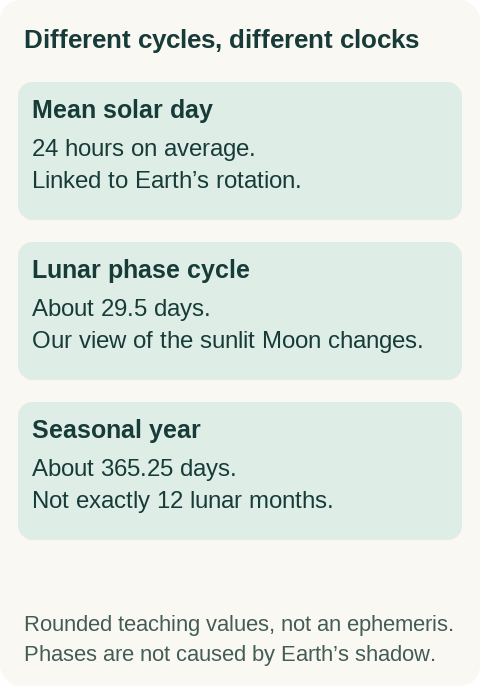
A mean solar day is 24 hours: an average interval based on the Sun returning to its highest position in the sky. A cycle of lunar phases takes about 29.5 days. The seasonal year is approximately 365 and a quarter days at this level of precision.
Here is an original comparison using rounded chapter values:
- Twelve lunar months: 12 x 29.5 = 354 days.
- Approximate solar year: 365.25 days.
- Difference: 365.25 - 354 = 11.25 days.
These rounded values explain why twelve lunar months do not keep the same position in the seasonal year. They are not a formula for predicting an actual festival date. Calendar calculations use more precise rules and astronomical information.
Calendars solve different matching problems
A lunar calendar follows lunar months. Without an adjustment to the seasonal year, its months shift through the seasons over successive years.
A solar calendar follows the seasonal year. Gregorian months have different lengths and do not each represent a complete cycle of lunar phases. Leap days help keep this calendar aligned with the year. The full Gregorian rule is more careful than "every fourth year": a year divisible by 100 is not a leap year unless it is also divisible by 400. Thus 1900 was not a leap year, while 2000 was.
A luni-solar calendar uses lunar months and adjustments, including an extra month in some years, to keep months connected with seasons. This is a different approach from adding one leap day. The Indian National Calendar is a solar calendar; it should not be grouped with all traditional calendars as if they used identical rules.
Festival dates can therefore shift when expressed in the Gregorian calendar. The shift depends on the calendar and its rules. Do not infer this year's local observance from a simplified classroom calculation.
Satellites are useful moving observers
The Moon is a natural satellite. Artificial satellites are human-made objects placed in orbit. Their uses include communication, navigation, weather observations, mapping and scientific research. Different purposes require different orbits; there is no single height or orbital period shared by every satellite.
A moving point of light is not enough evidence by itself to identify a particular satellite. Aircraft and other objects can also be seen in the sky. Treat identification as a question needing observations and a reliable reference.
Check your reasoning
- A student says the Moon becomes physically smaller during waning. What changes instead?
- Why is a half-lit Moon not evidence that Earth's shadow covers half of it?
- Using the rounded values above, how long are twelve lunar months?
- Is adding an extra month the same adjustment as adding a leap day?
- Does seeing almost the same lunar face imply that the Moon never rotates?
Answer check: (1) The visible fraction of its illuminated surface decreases. (2) Ordinary phases depend on viewing geometry; an eclipse is a different alignment. (3) About 354 days. (4) No; these adjustments belong to different calendar rules. (5) No; its rotation is matched to its revolution around Earth.
Observe safely, then explain
For a simple record, use teacher-selected Moon photographs or observe the Moon after dark with an adult from a safe location. Record missing observations honestly. Clouds are not evidence that the Moon stopped following its cycle. Never look directly at the Sun or search near it with binoculars, a telescope or a camera viewfinder. This guide does not provide a solar-viewing procedure.
Open the practice chapter chooser to inspect available sets; a dedicated set for this guide is not verified here.
Sources: NCERT Curiosity, Class 8 Science, Chapter 11, 2026-27 reprint; NASA Moon Viewing Tips and NASA eye-safety guidance. Questions, calculations and the diagram are original learning aids, not official exercise solutions or a current calendar forecast.
Written by
Evater Team