
Start with a place, then look for connections
A school garden contains more than a list of plants and animals. Leaves intercept sunlight, roots take up water, insects feed, birds hunt, and microorganisms break down dead material. Chapter 12 of NCERT Curiosity, How Nature Works in Harmony, asks us to connect those observations into an explanation of an ecosystem.
"Harmony" does not mean that every organism cooperates or that nothing changes. Predation, competition, disease and seasonal change are also part of ecological systems. The useful question is how organisms and physical conditions affect one another.
Individual, population, community, ecosystem
An individual is one organism. A population consists of organisms of the same species in a particular place at a particular time. Ten observed sparrows in a garden are not a population of "all birds" if several different species are being mixed together.
A community includes the different populations living and interacting in an area: plants, animals, fungi and other microorganisms. Add their interactions with non-living conditions, and you are studying an ecosystem.
The biotic components are living organisms. Abiotic components include sunlight, temperature, water and the mineral part of soil. Soil is not an empty, entirely lifeless material: it can contain roots, microbes and small animals as well as non-living particles and water. State which component you mean rather than putting every part of a soil sample into one box.
A habitat is the place where an organism lives. An ecosystem describes an interacting system, not merely an address. A pond, a farm and a small garden can all be studied as ecosystems, although their boundaries and management differ.
Food-chain arrows need a clear meaning
Green plants are producers because they make food by photosynthesis. Consumers obtain food from other organisms. Herbivores eat plants or plant products, carnivores eat animals, and omnivores eat both.
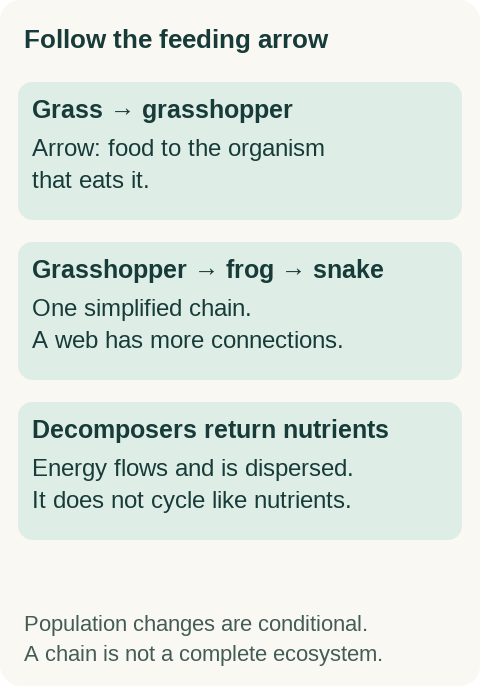
In a food chain, draw the arrow from the food to the organism eating it. For example:
Grass -> grasshopper -> frog -> snake
The first arrow means that the grasshopper obtains food from grass. It does not mean that the grass hunts the grasshopper. Always include an arrow key so the reader knows what your diagram means.
A trophic level is a feeding position in a particular chain. Producers occupy the first level; the organisms eating them occupy the next. An animal's position depends on the feeding relationship being shown. A familiar animal name is not a universal level label in every possible food web.
A web gives a better picture than one chain
One organism may eat several foods and may itself be eaten by more than one kind of animal. Connecting these feeding relationships produces a food web. A chain is one route through that network, not a complete picture of everything a species eats.
In the simplified grass chain, fewer frogs might allow more grasshoppers to survive, while snakes might have less food. Those are reasoned possibilities, not exact population forecasts. Other predators, alternative prey, disease, water and weather can change the outcome. Use words such as "may" and explain the assumptions instead of predicting a guaranteed number.
Decomposers connect dead matter with new growth
Bacteria and fungi break down dead organic matter and wastes into simpler substances. This decomposition helps return nutrients to the environment, where producers can use them again. Other organisms can assist by breaking material into smaller pieces.
A mushroom is a fungus, not a green plant making food by photosynthesis. Nor is every bacterium a decomposer in every situation. These are roles carried out by particular organisms, not labels that erase their diversity.
Keep nutrient cycling separate from energy transfer. Nutrients can move through organisms and return to soil or water. Energy passes through feeding relationships and is eventually dispersed as heat; it is not recycled endlessly around the same food chain. Decomposition is important, but it does not mean every human-made waste disappears harmlessly or quickly in nature.
Interactions include benefits, harm and competition
Mutualism is an interaction in which both partners benefit. A bee may obtain food from flowers while carrying pollen that helps the plant reproduce. Pollination is pollen transfer to a flower's stigma; it is not the same event as fertilisation.
In commensalism, one partner benefits while the other is not significantly affected in the example being considered. The chapter uses an orchid growing on a tree for support. This does not mean every plant growing on another plant is harmless in every circumstance.
In parasitism, one organism benefits at the expense of another. A tick feeding on a dog is the chapter's example. Competition occurs when organisms use a shared, limited resource, such as light, water, food or space. It can occur within a species and between species.
The labels describe the relationship and its effects. They are not moral judgments about "good" and "bad" organisms.
One change can travel through several links
Removing vegetation can reduce shelter and food, expose soil and alter water movement. The effects are connected, but the strength and direction of each link need evidence. In the chapter's pond example, changes involving fish, dragonflies and pollinators can affect nearby plants indirectly. A fish need not touch a flower to influence conditions relevant to its seed production.
Ecosystem balance is dynamic. Populations and resources fluctuate. Conservation does not aim to freeze every organism at one permanent number. Protecting habitats, movement routes, water and a variety of species can help maintain the processes on which organisms depend.
Farms and parks are human-managed ecosystems. Food production and conservation are not separate from ecology. Soil care, appropriate water use, protection of useful organisms and careful management of farm inputs all matter. A school revision guide is not a pesticide or fertiliser prescription.
An observation is not an invented result
Imagine a teacher-approved garden survey in which students count one named plant species in two equal areas. This is a proposed method, not a report of a survey we conducted. Record the area, date, identification method and count. A difference between two areas may suggest a question about shade or moisture, but does not alone prove the cause.
Observe from safe paths with an adult or teacher. Do not enter ponds, disturb nests, handle wild animals, taste unknown plants or fungi, or collect hazardous waste. Photographs and drawings can record relationships without harming the organisms.
Check your reasoning
- Are all the different bird species in a garden one population?
- What does the arrow from grass to a grasshopper mean?
- Why is a food web usually more informative than a single chain?
- Are energy transfer and nutrient cycling identical processes?
- If a predator declines, must every prey population increase by a fixed amount?
Answer check: (1) No; a population refers to the same species at a specified place and time. (2) The grasshopper obtains food from the grass. (3) It includes interconnected feeding relationships and alternative routes. (4) No; nutrients cycle, while energy flows through the system and is dispersed. (5) No; other interactions and abiotic conditions matter.
Open the practice chapter chooser to inspect available sets; a dedicated practice set for this guide is not verified here.
Source: NCERT Curiosity, Class 8 Science, Chapter 12, 2026-27 reprint. The survey, explanations, diagram and answer checks are original learning aids, not official exercise solutions or claims about a real school survey.
Written by
Evater Team