
One chapter, two kinds of comparison
A spoon of salt can dissolve in water, while sand remains a separate solid. A small stone can sink even when a much larger piece of wood floats. Chapter 9 of NCERT Curiosity, The Amazing World of Solutes, Solvents, and Solutions, connects observations like these to solutions, solubility, measurement and density.
Keep the comparisons separate. Solubility asks how much can dissolve under stated conditions. Density compares mass with volume. One word cannot replace the other.
Name the solute, solvent and solution
A solution is a uniform mixture. When a solid such as sugar dissolves in water, sugar is the solute and water is the solvent. The resulting mixture is the solution. The solute has not vanished from existence just because separate grains are no longer visible.
For a solution made from two liquids, the chapter uses the component in the larger amount as the solvent and the smaller amount as the solute. Do not turn that into a rule that the solvent must always have the greater mass in every kind of solution. In a concentrated sugar syrup, water is still the solvent.
Sand mixed with water is not a solution merely because both are in the same glass. Its components are not distributed as one uniform solution. Looking clear can be evidence, but appearance alone does not identify the substances or make an unknown liquid safe to drink.
Saturated is not another word for concentrated
An unsaturated solution can dissolve more of a particular solute at the stated temperature. A saturated solution has reached that solute's dissolving limit at that temperature. More solid can remain undissolved after adequate mixing.
A concentrated solution contains relatively more dissolved solute for a stated amount of solution or solvent than a dilute comparison. This describes a relative amount, not necessarily the saturation limit. A concentrated solution can still be unsaturated.
Suppose two original examples contain 6 g of salt in 100 g of water and 12 g in 200 g of water, with all salt dissolved. They have the same solute-to-water ratio. Doubling both quantities has not made the second one more concentrated. By contrast, 12 g in 100 g of water has a higher ratio. State what amount is being compared rather than counting spoons alone.
Temperature does not affect all solutes the same way
For many solid solutes, solubility in water increases with temperature. This is a general trend, not a promise for every substance. Heating a solution can also change other things, so it belongs in a teacher-led demonstration, not an instruction to heat an unknown liquid.
Gases show a different general trend: their solubility in water usually decreases as temperature rises. Dissolved oxygen matters for aquatic organisms. Do not explain this as oxygen being created from water whenever a fish needs it; dissolved oxygen and the oxygen chemically combined in water are different ideas.
Density needs both mass and volume
Density = mass / volume. Use compatible units. Grams divided by cubic centimetres gives g/cm³; kilograms divided by cubic metres gives kg/m³. For volume, 1 mL equals 1 cm³.
Mass is not the same as weight. Mass is measured in grams or kilograms, while weight is a force measured in newtons. A balance can display mass in grams even when its mechanism responds to force. Do not put newtons into a calculation that asks for density in g/cm³.
A larger object is not automatically denser. Two pieces of the same uniform material can have different masses and volumes but the same density under the same conditions.
Worked example: use the rise, not the final reading
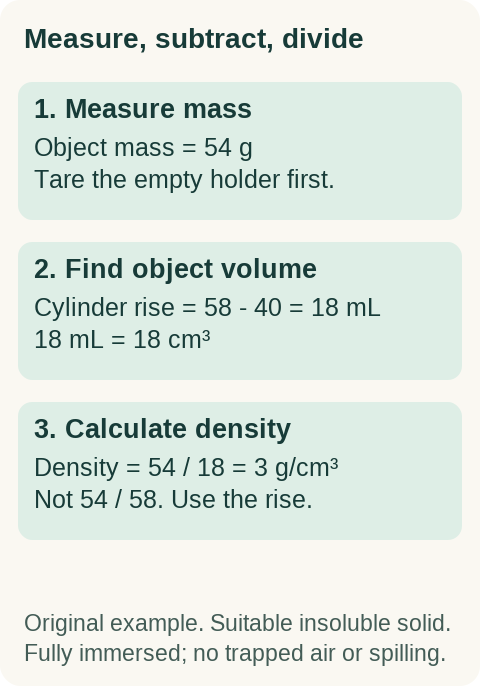
Imagine a suitable, insoluble solid with a measured mass of 54 g. A measuring cylinder initially reads 40 mL. After the object is fully immersed without trapped air or spillage, the reading is 58 mL.
- Volume displaced = 58 - 40 = 18 mL.
- Object volume = 18 cm³.
- Density = 54 / 18 = 3 g/cm³.
Dividing by 58 would use the total final cylinder reading, not the object's volume. For water in a measuring cylinder, read the bottom of the meniscus at eye level. Check the actual scale divisions; cylinders with the same general shape need not have the same smallest division.
Floating and heating need a careful comparison
For a simple solid-object comparison, density relative to the liquid helps explain floating or sinking. Consider the whole object's average density, including enclosed spaces, rather than saying "heavy objects sink". The chapter notes that density alone is not the only factor in every floating observation.
Heating generally increases volume without changing the amount of material in the comparison, so density decreases. Compressing a fixed amount of gas reduces its volume and increases its density. Water has an important exception to a simple cooling rule: ice has a lower density than liquid water and can float.
Check your reasoning
- Can a concentrated solution still be unsaturated?
- Are 6 g of solute in 100 g of water and 12 g in 200 g of water different solute-to-water ratios?
- In the worked example, why is the object volume 18 cm³ rather than 58 cm³?
- What is the density of a 72 g object with a volume of 24 cm³?
- Does warmer water generally dissolve more or less oxygen than colder water under a comparable gas-pressure condition?
Answer check: (1) Yes. Concentration and the dissolving limit are different. (2) No; the ratios are equal. (3) Object volume is the increase in reading. (4) 3 g/cm³. (5) Less, following the chapter's general gas-solubility trend.
Practise the method before the answer
Write the measured quantities, subtraction if needed, formula and unit before calculating. Use safe prepared examples: never taste laboratory mixtures or make a medical preparation from a revision guide. Open the practice chapter chooser to inspect current sets; a dedicated set for this guide is not verified here.
Source: NCERT Curiosity, Class 8 Science, Chapter 9, 2026-27 reprint. Numerical examples, questions and the diagram are original learning aids, not official exercise solutions or medical advice.
Written by
Evater Team